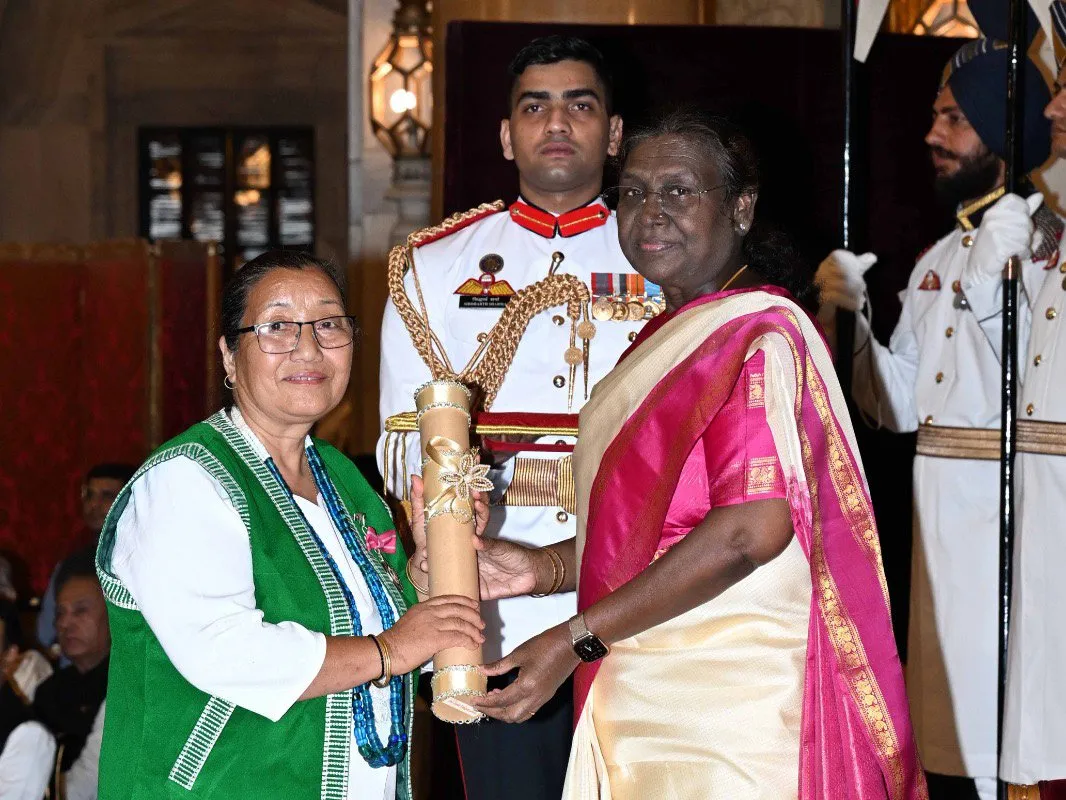
Ittisha Sarah
A social designer from Guwahati who helped the people of Arunachal's Sangti valley build their own village-run system for managing waste.
Ittisha Sarah (named in Mann Ki Baat as Iitisha) works with the people of the Sangti valley in Arunachal Pradesh’s West Kameng district to keep their river and fields free of waste. Her work was highlighted in episode 116 of Mann Ki Baat in November 2024 [1].
From Guwahati to Sangti
Sarah grew up in Guwahati, Assam, and studied economics in Pune before deciding a corporate job was not for her [2]. She then took a course in social design at Ambedkar University, Delhi, writing her dissertation on electronic waste [2][3]. With partners from The Batti Project she went on to set up the Northeast Waste Collective [2].
She first came to Sangti in 2018 as a tour instructor with a group of schoolchildren. Plastic left by visitors was spoiling the valley, and with the children she held its first clean-up and built a bamboo waste collection point shaped like the migratory black-necked crane [2][3].
A system the village runs
Work began in earnest around a community festival in early 2020, but the pandemic undid much of it [2]. In January 2023 Sarah rented a house in Sangti and started again, this time aiming for a system the villagers would run themselves [2].
The Monpa people of the valley keep several holy days each month by the Buddhist lunar calendar, when they do not farm. Sarah worked with them to use three of these days for waste: one for each household to help clean its neighbourhood, and two for collection [2][3]. Every household now separates its waste at home, a committee of residents collects it, and more than 100 women from self-help groups sort the dry waste at a materials recovery facility [2][3]. Brut reported that over 150 tonnes of waste have been kept out of the valley since 2020 [3].
West Kameng’s deputy commissioner told The Better India that the collective’s approach respects local sentiments [2]. In Mann Ki Baat, the Prime Minister cited the Sangti effort as an example of how small, steady efforts can bring large results [1][3].
Sources
- [1] PM's address in the 116th Episode of Mann Ki Baat — Prime Minister's Office (pmindia.gov.in). Accessed 12 October 2026.
- [2] How a remote Arunachal village is becoming zero-waste with community-driven waste management — The Better India. Accessed 12 October 2026.
- [3] Ittisha Sarah: The Woman Who Refused to Let a Valley Drown in Waste — Brut India. Accessed 12 October 2026.
Last updated . First draft prepared with AI assistance; reviewed and fact-checked by a person before publishing. Report a correction