Watching the Sun Without Blinking: India's Aditya-L1 Mission
Launched in September 2023, Aditya-L1 reached a point 1.5 million km from Earth in January 2024, where India's first solar observatory watches the Sun without interruption.
By IndianGaurav team ·
The Sun keeps us alive, but it also has a violent side. It throws out flares of radiation and huge clouds of charged gas called coronal mass ejections. When these reach the Earth they can disturb satellites, radio signals, navigation systems and power grids. Understanding the Sun better helps us prepare.
In 2023 India sent its first spacecraft dedicated to studying the Sun. It is called Aditya-L1, after Aditya, a Sanskrit name for the Sun [1].
A special place in space
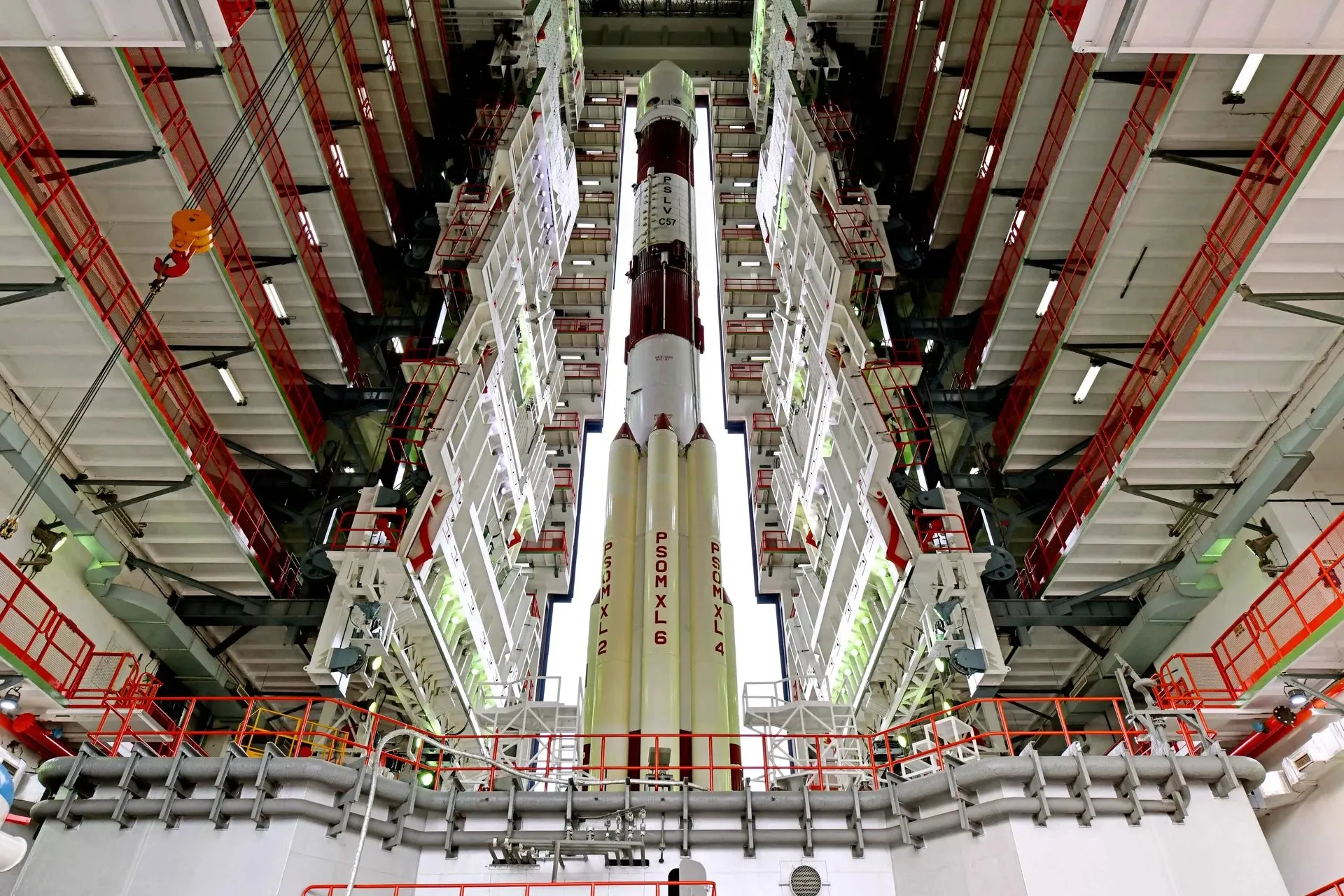
Aditya-L1 lifted off on a PSLV-C57 rocket on 2 September 2023 [1]. Its destination was a point in space called L1, the first Lagrange point of the Sun–Earth system, about 1.5 million kilometres from the Earth [1]. At L1 the pulls of the Sun and the Earth balance in a way that lets a spacecraft keep pace with the Earth as it travels around the Sun.
After a journey of about 127 days, ISRO placed the spacecraft into a halo orbit around L1 on 6 January 2024 [1][2]. It was the first time an Indian spacecraft had reached this point [2]. From there, Aditya-L1 has a constant view of the Sun, never blocked by the Earth or the Moon, so it can watch solar activity around the clock [1].
Seven instruments
Aditya-L1 carries seven scientific payloads [1]. Four look at the Sun from a distance:
- the Visible Emission Line Coronagraph (VELC), which studies the Sun’s outer atmosphere, the corona, and was built by the Indian Institute of Astrophysics in Bengaluru [1][2];
- the Solar Ultraviolet Imaging Telescope (SUIT), which photographs the Sun in near-ultraviolet light [1];
- SoLEXS and HEL1OS, two X-ray instruments that watch solar flares [1].
Three more measure conditions around the spacecraft itself: ASPEX and PAPA, which sample the particles of the solar wind, and a set of high-resolution magnetometers, mounted on a boom deployed after arrival at L1 [1][2].
Early results
The instruments began working even before arrival. HEL1OS recorded its first high-energy X-ray view of solar flares in November 2023, and in December 2023 SUIT took full-disc pictures of the Sun in near-ultraviolet light [1][2].
In May 2024 the Sun unleashed a series of powerful flares, followed by geomagnetic storms on Earth. Aditya-L1 was in position to record them: SUIT captured flares and sunspots, VELC observed the corona, and ASPEX picked up large changes in the stream of particles flowing past [2]. Its data has been released for scientists to use [2].
Why it matters
Aditya-L1 puts India among the few countries with an observatory watching the Sun from deep space. Its scientific goals include understanding how the corona and chromosphere are heated and what triggers solar eruptions such as flares and coronal mass ejections [1]. It can also give early warning of solar storms heading for the Earth, about an hour before the particles arrive [2]. That warning time could help protect the satellites that much of modern life now depends on.
Sources
- [1] Aditya-L1 — Indian Space Research Organisation (ISRO). Accessed 2 November 2026.
- [2] In 1 year, Aditya-L1 has found its sweet spot with an uninterrupted view of the Sun — ThePrint. Accessed 2 November 2026.
Last updated . Report a correction