Twenty Minutes Across the Sea: How Atal Setu Brought Mumbai and Navi Mumbai Closer
At about 21.8 km, Atal Setu is India's longest sea bridge. It was built to cut the Mumbai to Navi Mumbai journey from an hour to about 20 minutes.
By IndianGaurav team ·
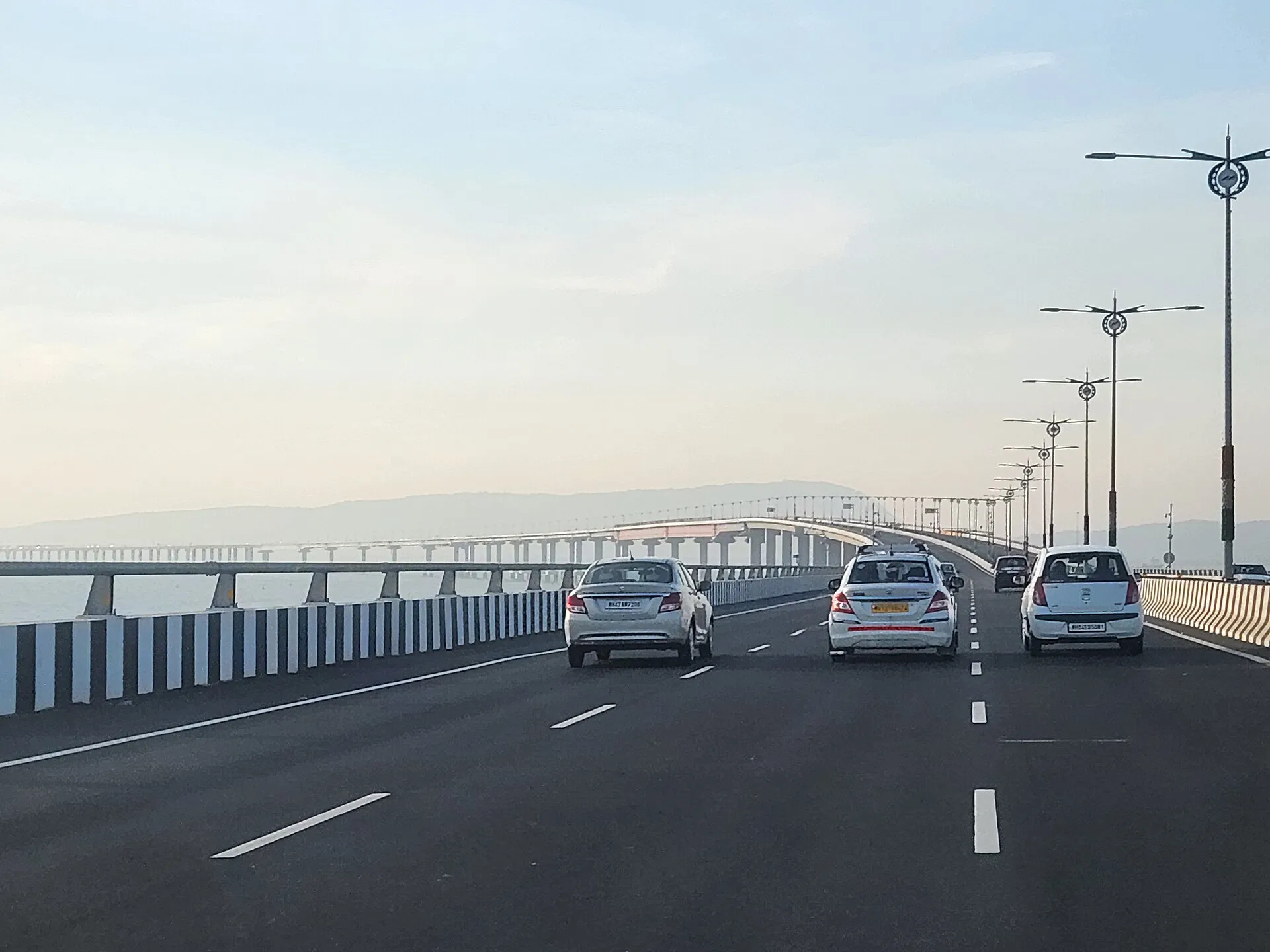
Mumbai’s main island is long and narrow, and for most of its history the only way from the city to Navi Mumbai and the mainland was the long road around the top of the harbour.
On 12 January 2024, Prime Minister Narendra Modi opened a road straight across the water. The Atal Bihari Vajpayee Sewri–Nhava Sheva Atal Setu, still widely known by its project name, the Mumbai Trans Harbour Link (MTHL), is about 21.8 kilometres long. The government describes it as India’s longest bridge and its longest sea bridge [1].
JICA, which lent most of the money, said the bridge would cut the journey between the two sides of the harbour from about 60 minutes to about 20 [2].
From foundation stone to opening
The foundation stone was laid in December 2016, and construction began in 2018 [1][2]. The project was run by the Mumbai Metropolitan Region Development Authority (MMRDA) [3].
The government put the cost at about ₹17,840 crore [1]. A large share came from the Japan International Cooperation Agency (JICA) as three loans totalling about ¥242 billion, roughly ₹13,715 crore [2].
A bridge mostly over water
Of the 21.8 kilometres, about 16.5 km run over the sea and about 5.5 km over land at the two ends. The bridge carries six lanes of traffic [1].
Some of the longest spans use orthotropic steel decks, a Japanese bridge technology that JICA says was used in India for the first time on this project [2]. A steel deck is much lighter than a concrete one, so the piers holding it up can be placed further apart.
Room for the flamingos
The bridge starts at Sewri, where wide mudflats draw large flocks of flamingos every winter. Building a road across their feeding grounds worried bird lovers from the start.
Several measures were written into the project. Maharashtra notified a flamingo sanctuary of about 1,690 hectares along Thane Creek as a trade-off for the bridge [4]. Noise barriers were fitted along the stretch over the mudflats to reduce disturbance from traffic [3]. MMRDA also funded studies by the Bombay Natural History Society (BNHS) on how to limit harm to the birds [5].
The record is mixed. BNHS counts reported by Mongabay found far fewer flamingos at Sewri during construction in early 2020 than a year before [5]. Whether the birds return in their old numbers is something to keep watching.
What it connects
Atal Setu runs from Sewri in central Mumbai to Nhava Sheva on the Navi Mumbai side [1]. From there, drivers can reach [2]:
- Navi Mumbai, one of the region’s fastest-growing cities
- the new Navi Mumbai International Airport
- Jawaharlal Nehru Port, one of India’s busiest container ports
- the Mumbai–Pune Expressway
Skipping the crowded roads around the harbour saves fuel and time for commuters, and it helps lorries carrying goods to and from the port.
Why it matters
Planning a road across Mumbai’s harbour was the easy part. Building one, in deep water, through monsoons and beside a bird habitat, took most of a decade. The bridge is named after former Prime Minister Atal Bihari Vajpayee [1], and it is one of several projects, along with new metro lines and the new airport, changing how people move around one of the world’s most crowded cities.
For someone who used to spend an hour each way in traffic, the bridge’s biggest gift is simple: time back in the day.
Sources
- [1] PM inaugurates Atal Bihari Vajpayee Sewri-Nhava Sheva Atal Setu in Navi Mumbai — Press Information Bureau, Government of India. Accessed 11 October 2026.
- [2] Hon'ble Prime Minister Mr. Narendra Modi Inaugurates JICA-funded Mumbai Trans-Harbour Link – India's Longest Sea Bridge — Japan International Cooperation Agency (JICA). Accessed 11 October 2026.
- [3] Mumbai Trans Harbour Link — project overview — Mumbai Metropolitan Region Development Authority (MMRDA). Accessed 11 October 2026.
- [4] Mumbai gets a flamingo sanctuary as trade-off for trans-harbour sea-link — Mongabay India. Accessed 11 October 2026.
- [5] Urban projects, human settlements close in on Mumbai's bird habitats — Mongabay India. Accessed 11 October 2026.
Last updated . Report a correction