Nine Kilometres Under the Mountain: The Tunnel That Ended Lahaul's Winter Isolation
The 9.02 km Atal Tunnel under the Rohtang Pass is certified as the longest highway tunnel in the world above 10,000 feet. It keeps the Lahaul valley connected all year.
By IndianGaurav team ·
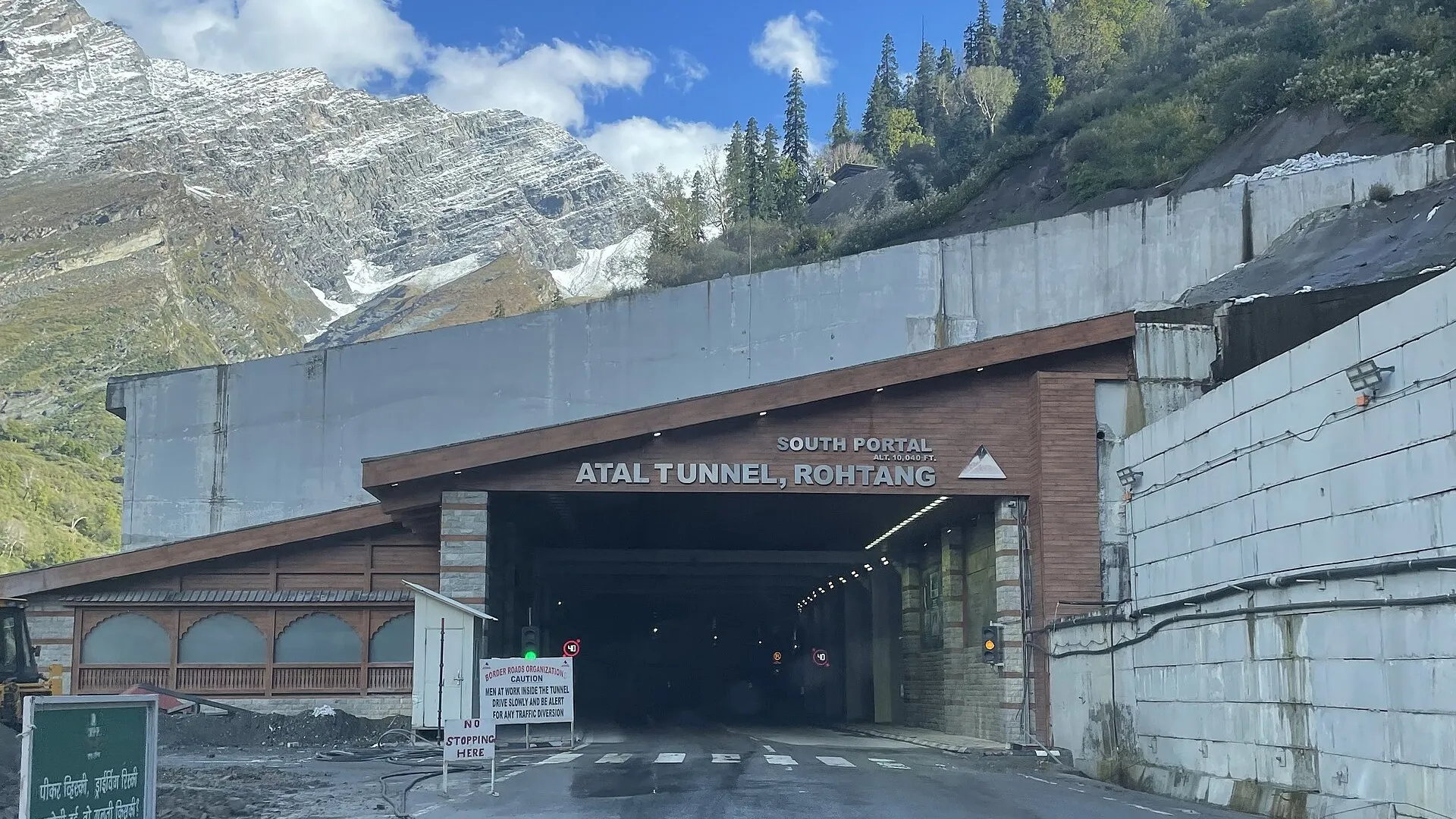
For generations, the people of the Lahaul valley in Himachal Pradesh lived by the snow. Every winter, heavy snowfall closed the road over the Rohtang Pass, and the valley was cut off from Manali and the rest of the country for about six months a year [1].
Families stocked up on food, fuel and medicine before the pass closed. A serious illness in January could mean a long wait for help.
On 3 October 2020, Prime Minister Narendra Modi dedicated the Atal Tunnel to the nation [2]. The 9.02-kilometre road tunnel runs right under the Rohtang Pass, and the valley now stays connected all year [1].
A decision two decades old
Prime Minister Atal Bihari Vajpayee’s government decided on 3 June 2000 to dig a tunnel under Rohtang [1]. Two years later, on 26 May 2002, work formally began with a foundation stone for the road leading to the tunnel’s southern end [1].
The work fell to the Border Roads Organisation (BRO), which builds roads in India’s hardest border terrain [1]. In December 2019, the Union Cabinet named the Rohtang Tunnel after Vajpayee [1].
Digging through the Pir Panjal
The tunnel sits at about 3,000 metres (10,000 feet) in the Pir Panjal range of the Himalayas [1]. The south portal is about 25 km from Manali; the north portal is near the village of Teling, by Sissu, on the Lahaul side [1].
The hardest stretch was the Seri Nalah fault zone, 587 metres of broken rock where water seeped in from a stream above [1][2]. Crews had to fight flooding and loose ground for years.
The two ends finally met on 15 October 2017 [1]. It took three more years to lay the road and fit the lighting, ventilation and safety systems.
Built for safety
The Atal Tunnel is a horseshoe-shaped, single tube with two lanes and an 8-metre roadway [1]. A long tunnel is dangerous if there is a fire or crash, so it was packed with safety systems [1]:
- a fireproof emergency escape tunnel built into the main tunnel itself
- telephones every 150 metres
- fire hydrants every 60 metres
- CCTV with automatic incident detection every 250 metres
- air quality checks every kilometre
- exit signs and evacuation lighting every 25 metres
- a public address system running the whole length
It was designed for 3,000 cars and 1,500 trucks a day, at speeds of up to 80 km/h [1].
What it changed
- Shorter journeys. The tunnel cuts the road between Manali and Leh by 46 km and saves about four to five hours [1].
- Year-round access. People in Lahaul can now reach hospitals, markets and jobs in winter.
- A second winter route to Ladakh. Before the tunnel, the only winter road into Ladakh ran through Kashmir. Now there is a route through Himachal Pradesh too [1].
A record
On 9 February 2022, the World Book of Records, a UK-based organisation, certified the Atal Tunnel as the world’s longest highway tunnel above 10,000 feet [3]. The BRO’s Director General received the award in New Delhi [1].
Why it matters
From the decision in 2000 to the opening in 2020, the tunnel took twenty years, and every metre of it was dug through cold, wet and unstable rock.
For the people of Lahaul, the result is simple: they are no longer cut off when the snow falls.
Sources
- [1] Factsheet: Atal Tunnel – World's Longest Highway Tunnel — Press Information Bureau, Government of India. Accessed 11 October 2026.
- [2] Prime Minister dedicates to the Nation the Atal Tunnel — Press Information Bureau, Government of India. Accessed 11 October 2026.
- [3] Atal Tunnel officially recognised as 'Longest Highway Tunnel above 10,000 feet' by World Book of Records — Press Information Bureau, Government of India. Accessed 11 October 2026.
Last updated . Report a correction