Where No One Had Landed Before: How Chandrayaan-3 Put India on the Moon's South Pole
On 23 August 2023, India became the first country to land a spacecraft near the Moon's south pole. Here is the story of the mission and the people behind it.
By IndianGaurav team ·
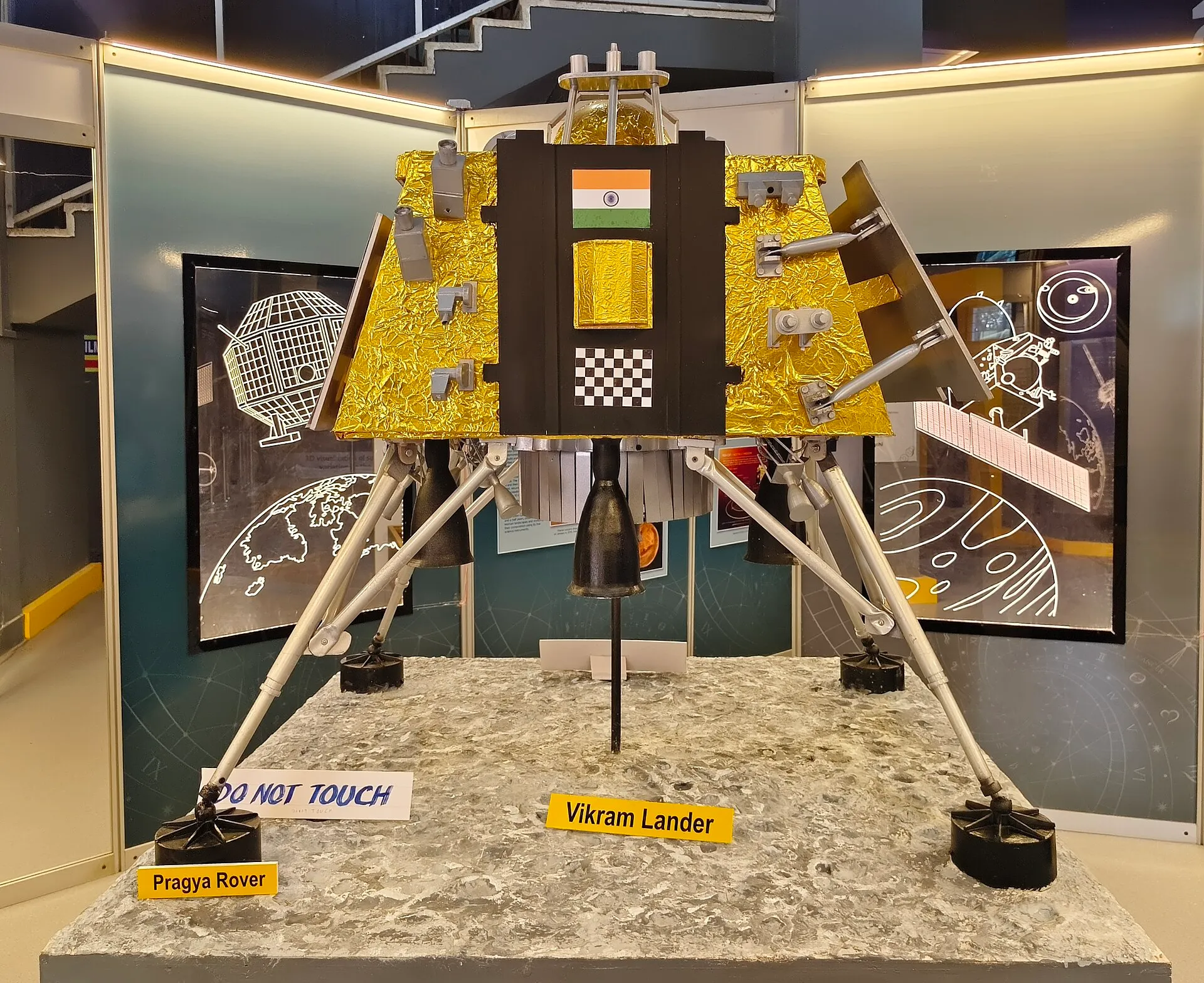
At about six in the evening on 23 August 2023, millions of Indians were watching the same live broadcast. Classrooms had wheeled in televisions. Offices had paused work. Families crowded around phones.
On the screen, a small lander called Vikram was descending towards a part of the Moon that no spacecraft had ever reached safely. A few minutes later, the mission control room in Bengaluru broke into applause. India had become the fourth country in history to make a soft landing on the Moon, after the United States, the former Soviet Union and China, and the first to do it near the lunar south pole [3][4].
This is the story of Chandrayaan-3, and why it matters far beyond one evening of celebration.
Why the south pole?
Most earlier Moon landings, including the famous Apollo missions, touched down near the Moon’s equator. The terrain there is easier and the sunlight is more predictable.
The region around the south pole is different. It has deep craters, some of which never see sunlight. Scientists believe these permanently shadowed areas may hold water ice, trapped for billions of years. If that ice exists in useful amounts, it could one day provide drinking water, oxygen and even rocket fuel for future explorers. That makes the south pole one of the most interesting places on the Moon, and one of the hardest to land on, because its surface is rough and full of craters and boulders [3][4].
Learning from a setback
Chandrayaan-3 did not come out of nowhere. Its story really begins with its predecessor.
In September 2019, Chandrayaan-2’s lander, also named Vikram, lost contact in the final moments of its descent and crashed on the lunar surface [2][4]. It was a painful moment for the country.
What is often forgotten is that Chandrayaan-2’s orbiter was a success. It went on to circle the Moon and send back valuable data for years [2][4]. And ISRO’s engineers did what good engineers do: they studied every detail of what went wrong.
Chandrayaan-3 was designed with that failure in mind. The new lander had stronger legs, more solar panels, extra sensors, a larger landing zone, and software that could cope with more things going wrong. The team’s approach was simple: instead of designing for success, design for failure, and make sure the lander can still land if several things don’t go to plan [1][3].
The journey
Chandrayaan-3 lifted off on 14 July 2023 on ISRO’s heavy-lift LVM3 rocket from the Satish Dhawan Space Centre in Sriharikota, Andhra Pradesh [1].
Rather than flying straight to the Moon, the spacecraft took a patient, fuel-saving route. It circled the Earth in larger and larger loops, then slipped into lunar orbit on 5 August. Over the following days, its orbit was gradually tightened. On 17 August, the lander module separated from the propulsion module and began its own final approach [3].
The mission had three parts:
- A propulsion module, which carried the lander to lunar orbit.
- The Vikram lander, named after Dr Vikram Sarabhai, the founder of India’s space programme [4].
- The Pragyan rover, a six-wheeled robot carried inside the lander. Its name means “wisdom” in Sanskrit [4].
Twenty minutes of terror
Space engineers often describe the final descent to the Moon as “minutes of terror”. There is no air to slow a spacecraft down, and no pilot on board. Everything depends on the lander’s own sensors and software.
Vikram fired its engines to brake from orbital speed, scanned the ground below for a safe spot, and adjusted its position on its own. Then, at 6:04 pm Indian time, it touched down gently at around 69 degrees south latitude [1][4].
The landing point was later named Shiv Shakti Point. The spot where Chandrayaan-2’s lander had come down in 2019 was named Tiranga Point, so that the earlier effort would also be remembered. These names were announced by the Prime Minister on 26 August 2023, along with the decision to mark 23 August every year as National Space Day [7].
What the mission found
Landing was only the start. The lander and rover were designed to work for about one lunar day, which lasts roughly 14 Earth days, before the freezing lunar night set in.
In that short window, they did a remarkable amount of science:
- The Pragyan rover rolled out of the lander and travelled more than 100 metres across the surface, carefully steering around craters [5].
- An instrument on the rover used laser pulses to analyse the soil. It confirmed the presence of sulphur near the south pole, along with elements such as aluminium, calcium, iron, chromium, titanium, manganese, silicon and oxygen [3][5].
- A probe on the lander, called ChaSTE, pushed about 10 centimetres into the ground and recorded how temperature changes with depth. It showed that the surface heats up sharply in sunlight while the soil just below stays much cooler. This is the first temperature profile of its kind from the south polar region [3].
- A seismometer on the lander recorded small vibrations, which may help scientists understand what is happening beneath the surface [3][5].
Near the end of the lunar day, ISRO tried something bold. On 3 September, it commanded Vikram to fire its engines again. The lander lifted off the surface by around 40 centimetres and landed again a short distance away. This “hop” tested technology that India will need for future missions that bring samples back to Earth [5].
Even the propulsion module had a second life. With more than 100 kg of fuel left over, ISRO steered it out of lunar orbit and into an orbit around Earth, gaining practical experience in returning a spacecraft from the Moon [6].
Small budget, big ambition
Chandrayaan-3 was also notable for what it cost. Widely reported estimates put the mission at about ₹615 crore, less than the budget of some feature films [9]. This reflects ISRO’s long-standing approach: careful engineering, reuse of proven designs, and strong in-house talent.
The mission was led by ISRO chairman S. Somanath and project director P. Veeramuthuvel, but, as Somanath said on landing day, it was the work of a whole generation of ISRO scientists [3][4].
Why it matters
The success of Chandrayaan-3 was celebrated around the world. In October 2024, the International Astronautical Federation gave its World Space Award to the ISRO team behind the mission, at a ceremony in Milan [8].
But its biggest impact may be at home. For a generation of Indian children, the image of a lander bearing the Indian flag on the Moon has become a symbol of what is possible.
ISRO has already moved on to what comes next, using lessons from the hop and the propulsion module’s return for future missions [5][6].
The lesson of Chandrayaan-3 is worth remembering long after the cheering has faded. In 2019, India fell short. In 2023, it got back up, learned from its mistakes, and went somewhere no one had gone before. That is a story every Indian can be proud of.
Sources
- [1] Chandrayaan-3 mission details — Indian Space Research Organisation (ISRO). Accessed 11 October 2026.
- [2] Chandrayaan-2 mission — ISRO. Accessed 11 October 2026.
- [3] Chandrayaan-3 — Wikipedia. Accessed 11 October 2026.
- [4] Chandrayaan-3: India makes historic landing near Moon's south pole — BBC News. Accessed 11 October 2026.
- [5] What did Chandrayaan-3 mission manage to accomplish? — The Week. Accessed 11 October 2026.
- [6] Returns to home Earth: Chandrayaan-3 Propulsion Module moved from Lunar orbit to Earth's orbit — Indian Space Research Organisation (ISRO). Accessed 11 October 2026.
- [7] 23rd August, day of Chandrayaan-3 landing on Moon to be observed as National Space Day; Landing site to be called Shiv Shakti, announces PM Modi — News On AIR (Prasar Bharati). Accessed 11 October 2026.
- [8] ISRO chairman receives IAF World Space Award for Chandrayaan-3 — Deccan Herald (PTI). Accessed 11 October 2026.
- [9] Chandrayaan-3 cost less than 'Barbie', 'Oppenheimer' - and even 'Adipurush' — Morung Express (IANS). Accessed 11 October 2026.
Last updated . Report a correction