Taller Than the Eiffel Tower: The Railway Bridge That Finally Connected Kashmir
Standing 359 metres above the Chenab river, India's Chenab Rail Bridge is the highest railway bridge in the world.
By IndianGaurav team ·
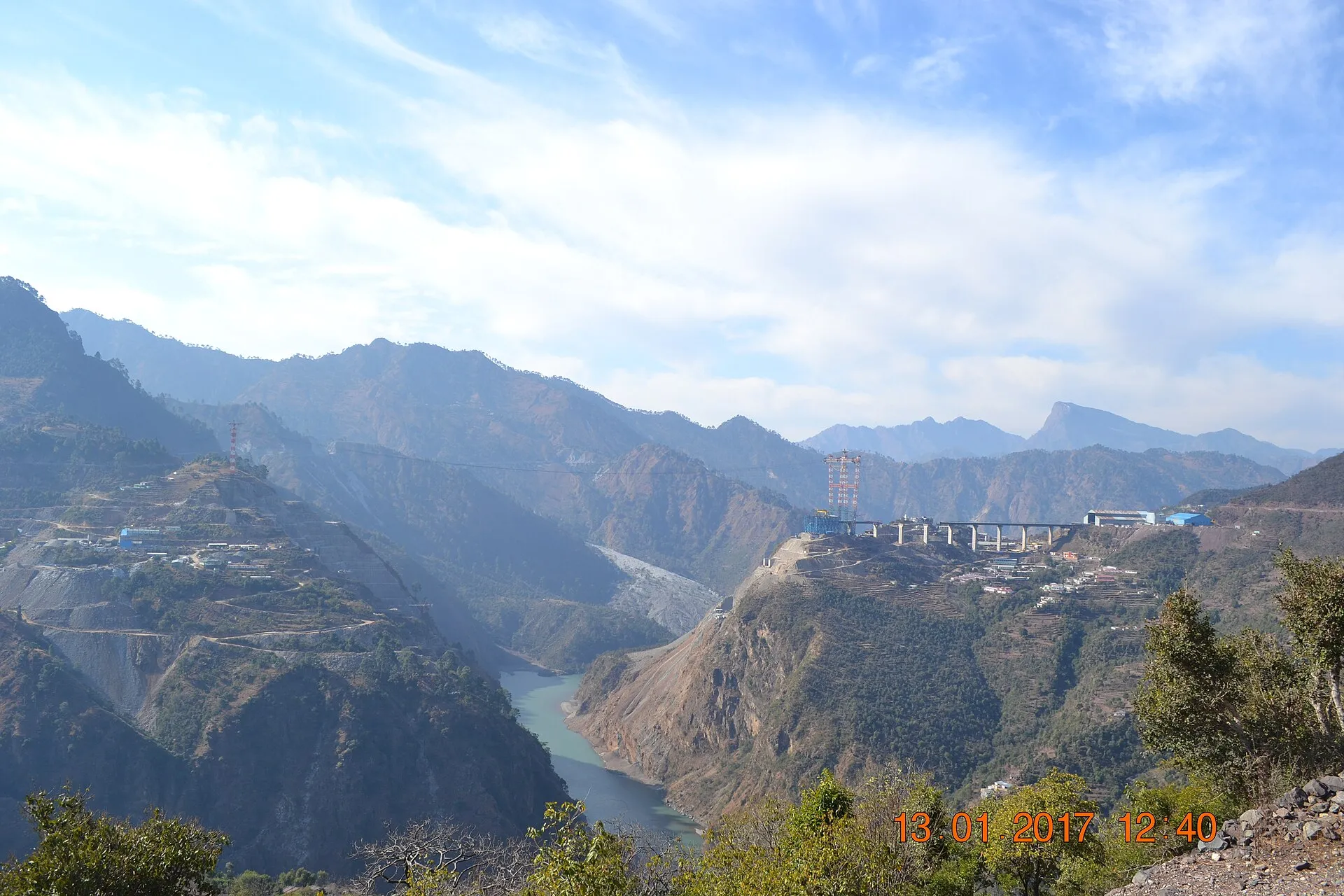
Deep in the Reasi district of Jammu and Kashmir, the Chenab river cuts through a steep, rocky gorge. For centuries, the only way across was a long, winding journey through the mountains.
Today, a graceful steel arch leaps from one side of that gorge to the other. Its deck sits 359 metres above the riverbed, about 35 metres higher than the top of the Eiffel Tower [1][2]. Trains glide across it in less than a minute.
This is the Chenab Rail Bridge, the highest railway bridge in the world [1][4]. It took years of work, and it has changed travel to and from the Kashmir valley.
A missing link
For most of India’s history after Independence, the Kashmir valley had no railway link to the rest of the country. A railway line ran within the valley, but anyone travelling from Jammu to Srinagar had to go by road over the mountains. In winter, heavy snow and landslides could shut the highway for days, cutting off supplies and leaving travellers stranded.
To solve this, Indian Railways began the Udhampur–Srinagar–Baramulla Rail Link, or USBRL. It is one of the most difficult railway projects ever attempted anywhere. The full project includes 36 tunnels covering about 119 kilometres and around 943 bridges, built through young, unstable Himalayan mountains [3].
The single hardest piece of the puzzle was the crossing over the Chenab gorge, between the villages of Kauri and Bakkal, about 23 kilometres north of Katra [1].
Why an arch?
The gorge is too deep for an ordinary bridge with tall piers standing in the river. The answer was a giant steel truss arch, anchored into the rock on both sides, with the railway deck resting on top [4].
The numbers are striking:
- Height: 359 metres from the riverbed to the deck [1][2].
- Total length: about 1,315 metres [1][4].
- Main arch span: about 467 metres [4].
- Design life: about 120 years [1].
- Wind resistance: built to cope with winds of up to 260 km/h [1].
- Cost: roughly ₹1,486 crore [1].
Building in the clouds
Building an arch this high over a gorge this deep was a feat in itself [1].
The two halves of the arch were built outwards from each side of the gorge, piece by piece, held in place by cables from tall temporary towers, until they met in the middle [1][5].
Engineers also had to account for the region’s high earthquake risk, and designed the bridge to withstand strong earthquakes [1].
Security was another concern in a sensitive region. The bridge has been designed to withstand blasts, and it is monitored by a network of sensors that track its health [1].
The two halves of the arch finally met on 8 April 2021. The “golden joint” that completed the deck followed in August 2022 [4][5]. Track laying and trial runs came next.
Opening day
On 6 June 2025, Prime Minister Narendra Modi formally opened the Chenab Rail Bridge to rail traffic [2][4]. On the same day, he also opened the nearby Anji Khad Bridge, India’s first cable-stayed railway bridge, and flagged off Vande Bharat trains between Katra and Srinagar [3].
For the first time, the Kashmir valley was connected to the rest of India’s railway network by a continuous line. The Vande Bharat service cut the journey between Katra and Srinagar to around three hours, saving two to three hours compared with the road [2].
What it means for people
For the people of Jammu and Kashmir, the bridge is not just an engineering record. It is a practical lifeline.
- Travel is faster and less dependent on the mountain highway, which snow and landslides can close.
- Farmers and traders gain a rail route to markets across India.
- Students, patients and workers have another way to reach the rest of the country.
Who built it
The bridge was built for Indian Railways through Konkan Railway Corporation, with Mumbai-based Afcons Infrastructure as the main contractor in a joint venture [5]. Design specialists from Finland and Germany worked on it alongside Indian engineers and workers, in some of the hardest conditions imaginable [4].
A bridge as a symbol
Bridges have always carried meaning beyond their steel and concrete. They join what was separate.
The Chenab Rail Bridge joins two sides of a Himalayan gorge. More importantly, it joins the Kashmir valley more closely to the rest of the country. When a train crosses that arch, high above the river, it carries passengers, goods and something harder to measure: a stronger sense of connection.
It is fitting that the highest railway bridge in the world sits in India’s most beautiful mountains. And it is a reminder that the hardest projects, when finished, are the ones a nation remembers longest.
Sources
- [1] Chenab Rail Bridge — Wikipedia. Accessed 11 October 2026.
- [2] PM Modi inaugurates Chenab Bridge, world's highest railway bridge — Greater Kashmir. Accessed 11 October 2026.
- [3] PM Modi Inaugurates World's Highest Chenab Rail Bridge in Jammu & Kashmir — NBM&CW. Accessed 11 October 2026.
- [4] Railway Bridge across the Chenab River in Jammu and Kashmir, India — LAP Consult (arch design engineers). Accessed 12 October 2026.
- [5] J-K: World's highest Chenab railway bridge's golden joint completed — DT Next (ANI). Accessed 12 October 2026.
Last updated . Report a correction