Dolphins, Flamingos and Two Lakh Fishers: The Comeback Story of Chilika Lake
Chilika in Odisha is Asia's largest brackish-water lagoon and the world's biggest single home of Irrawaddy dolphins. Its recovery is a conservation success.
By IndianGaurav team ·
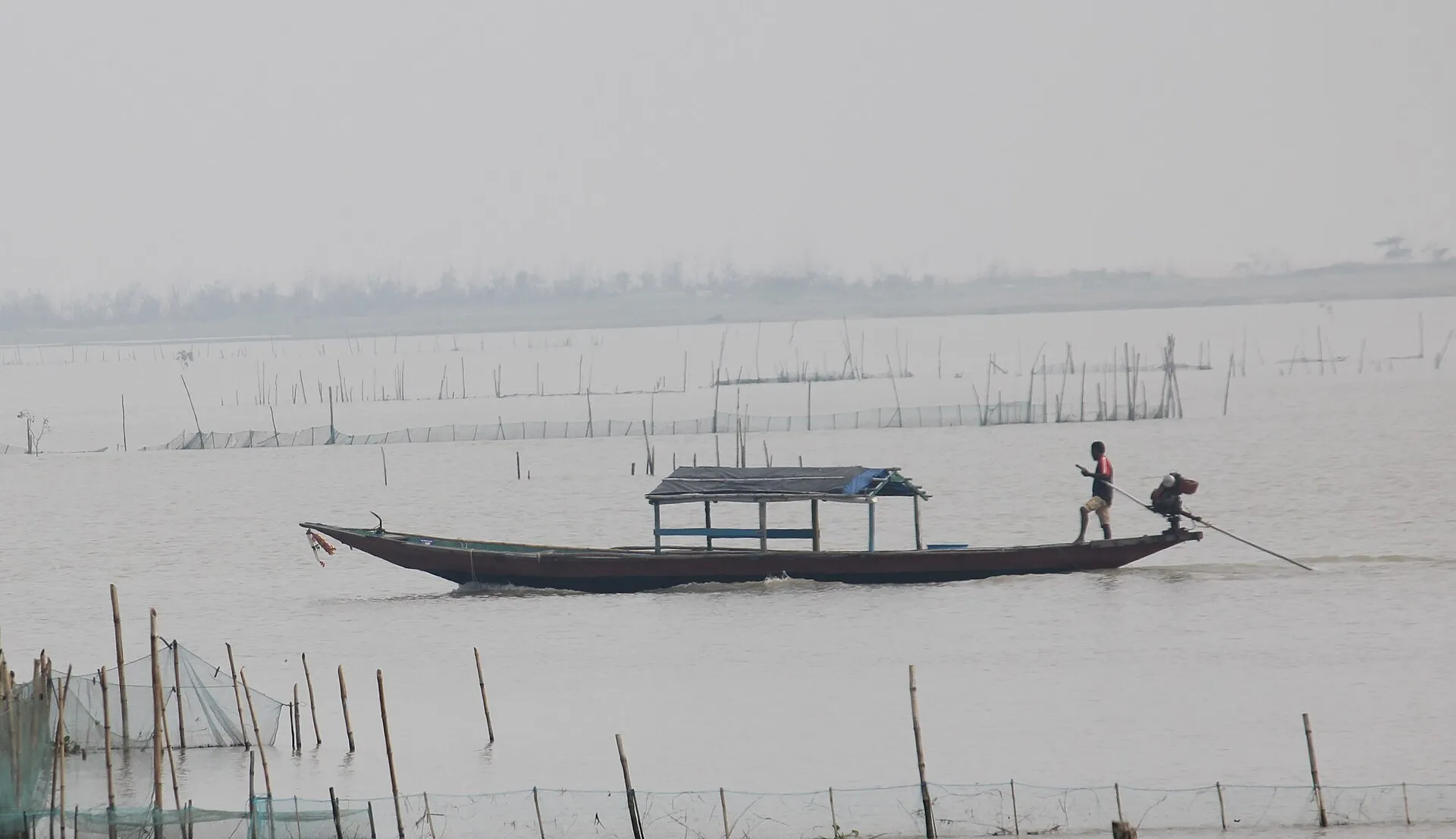
On a winter morning at Chilika Lake in Odisha, the water is calm and silver. Fishing boats drift past rows of bamboo stakes. Now and then a smooth grey back rolls above the surface: an Irrawaddy dolphin coming up to breathe.
Chilika is Asia’s largest brackish-water lagoon and one of India’s most important wetlands [5]. It is also one of the country’s best conservation comebacks.
Where the rivers meet the sea
Chilika lies on the Odisha coast, about 50 km south-west of Puri, across the districts of Puri, Khordha and Ganjam [3]. It is a lagoon: a shallow body of water cut off from the sea by a strip of sand, but joined to it by an opening called a mouth.
Fresh water pours in from dozens of rivers and streams, while salt water flows in from the Bay of Bengal [1]. The mix is brackish, partly salty and partly fresh. The lake covers about 1,165 square kilometres in the monsoon and shrinks to around 900 square kilometres in summer [1][3].
In 1981, Chilika became India’s first Ramsar site, a wetland of international importance under the global treaty that protects wetlands [1][3].
A lake in trouble
By the 1990s, Chilika was choking. Silt was building up, and the channel to the sea had grown long and kept shifting, so less sea water could get in [4]. Freshwater weeds spread across the lake, and fish catches collapsed. Before the rescue, the average yearly catch had fallen to about 1,600 tonnes [4].
In 1993, Chilika was put on the Montreux Record, the Ramsar list of wetlands under serious threat [2].
How Chilika was saved
The Government of Odisha set up the Chilika Development Authority (CDA) in 1991 to look after the lake [1]. Acting on studies by the Central Water and Power Research Station in Pune, the CDA cleared silt from the old channel and, on 23 September 2000, opened a new mouth to the sea. The new opening cut the outflow channel by about 18 km, so tides could flow in and out more freely [4].
The CDA’s own figures show how fast things changed [4]:
- The fish catch jumped to almost 12,000 tonnes in 2001–02 and passed 14,000 tonnes in 2003–04.
- The crab catch, down to just 10 tonnes in 1999–2000, rose to over 150 tonnes.
- Invasive freshwater weeds shrank by about 172 square kilometres.
- Seagrass beds improved.
On 11 November 2002, Chilika was taken off the Montreux Record [2], the first site in Asia to be removed [1]. That year the CDA also received the Ramsar Wetland Conservation Award [2][3].
Home of the Irrawaddy dolphin
The Irrawaddy dolphin has a rounded head and no beak. It lives in coastal waters, estuaries and a few rivers in South and Southeast Asia, and it is protected under Schedule I of India’s Wildlife (Protection) Act [1].
A survey in February 2018 counted 155 Irrawaddy dolphins in Chilika, up from about 100 the year before. That made Chilika the single largest habitat of the species in the world [1]. The dolphins, once found mostly in the outer channel, have spread into parts of the lake that illegal fish pens used to occupy [1].
A winter home for birds
Every winter, about nine lakh birds gather at Chilika, making it the largest wintering ground for migratory waterbirds in the Indian subcontinent [1].
At the centre of the lake lies Nalabana Island, a notified bird sanctuary [3]. Its mudflats, exposed from December to May, draw more than three lakh waterbirds [1].
People of the lake
Chilika feeds people too. About two lakh people depend on its fisheries for a living [1]. When the catch came back after 2000, average yearly income for fishing families rose by more than ₹50,000, according to the CDA [4].
The work goes on
Recovery is not a finish line. Cyclone Phailin in 2013 badly damaged the seagrass beds [1], and silt, pollution and illegal fish pens remain constant pressures. Chilika needs watching every year.
Why it matters
Chilika shows that a damaged ecosystem can come back when science, government and local communities work together. A lake on the world’s danger list in 1993 was held up as a model of restoration within ten years.
Today, when a dolphin breaks the surface or a flock of flamingos lifts off from Nalabana, it is a living reminder of what that work achieved.
Sources
- [1] Chilika Lake emerges as single largest habitat of Irrawaddy dolphins in the world — Mongabay India. Accessed 11 October 2026.
- [2] Chilika Lake — Ramsar Sites Information Service — Ramsar Convention Secretariat. Accessed 11 October 2026.
- [3] Chilika at a Glance — Chilika Development Authority, Government of Odisha. Accessed 11 October 2026.
- [4] Eco-Restoration — Chilika Development Authority, Government of Odisha. Accessed 11 October 2026.
- [5] Integrated Coastal Zone Management Project — Chilika — Chilika Development Authority, Government of Odisha. Accessed 11 October 2026.
Last updated . Report a correction