Why Is the Sea Blue? The Question That Won India Its First Science Nobel
In 1930, C.V. Raman became the first Asian to win a Nobel Prize in science, for a discovery made with simple equipment in Kolkata.
By IndianGaurav team ·
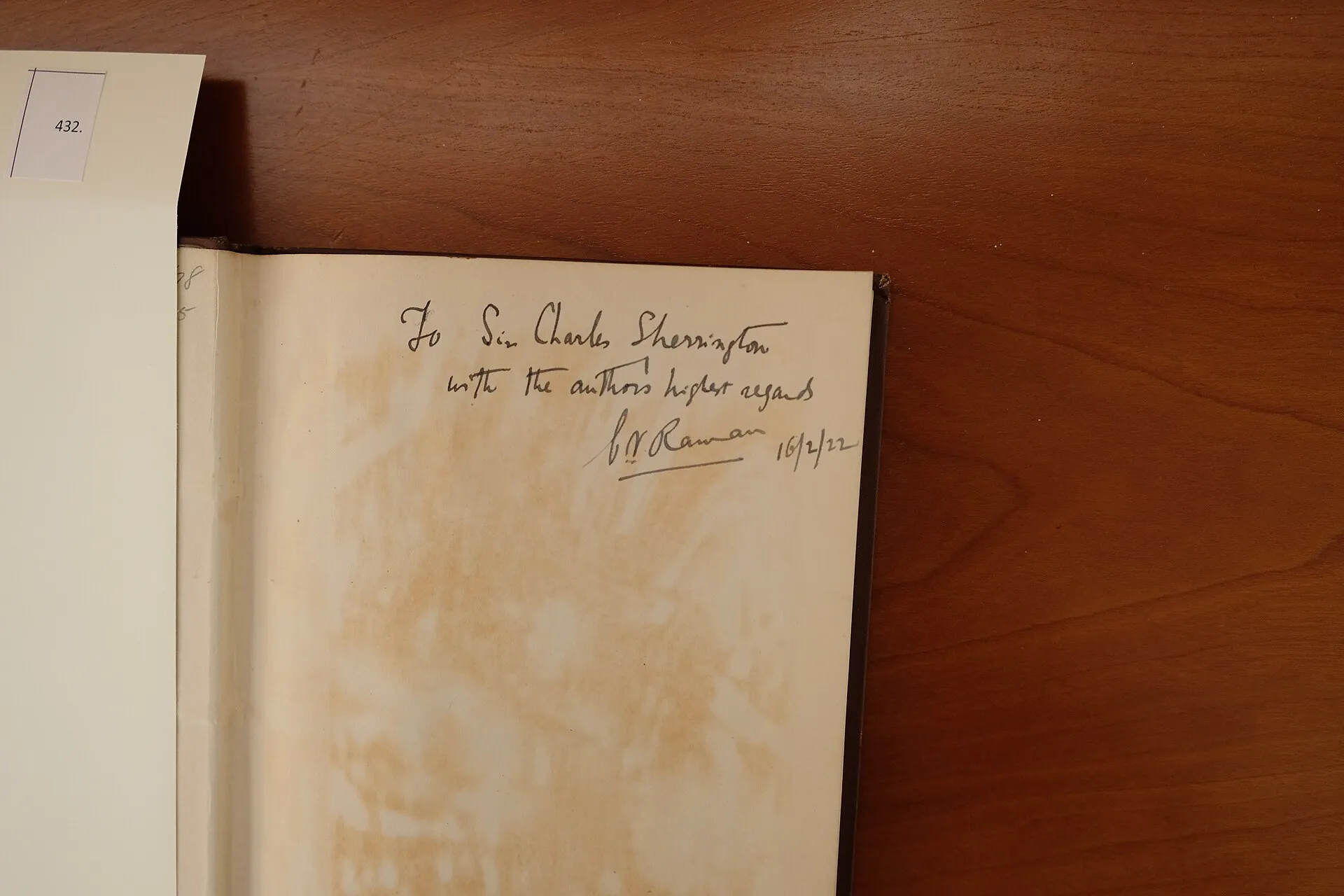
In 1921, an Indian physicist was sailing back from England to India across the Mediterranean Sea. Standing on deck, he looked at the deep blue water and asked himself a simple question: why is the sea blue [2]?
The accepted explanation at the time was that the sea simply reflected the colour of the sky. He was not convinced. Using a small pocket instrument, he studied the light from the water on the voyage itself. He came to believe that the water was scattering sunlight, in much the same way the air does [2].
That curiosity on a ship’s deck set off years of research. It ended with a discovery that won him the Nobel Prize in Physics in 1930, making him the first Asian, and the first non-white person, to win a Nobel Prize in any branch of science [1][2].
His name was Chandrasekhara Venkata Raman, known to the world as C.V. Raman.
A brilliant student
Raman was born on 7 November 1888 in Tiruchirappalli, in present-day Tamil Nadu [1][2]. His father was a lecturer in mathematics and physics, and the household was full of books and learning.
Raman was a remarkable student. He finished school very young and earned his bachelor’s degree from Presidency College, Madras, coming first in his class and winning a gold medal in physics. While still a student, he published his first research paper in a respected British science journal [2].
Despite his talent, opportunities for scientists in British India were limited. Raman took a job in the government’s Finance Department in Calcutta (now Kolkata). But he could not stay away from science.
Science after office hours
In Calcutta, Raman discovered the Indian Association for the Cultivation of Science, a research institute founded by Mahendralal Sircar. He began doing experiments there in the early mornings and evenings, before and after his office work [2].
His early research was on the physics of sound and musical instruments, including the violin and Indian instruments such as the veena, mridangam and tabla. He was fascinated by why the Indian drums produce such clear, musical tones.
In 1917, he gave up his secure government job to become a professor of physics at the University of Calcutta. He took a large cut in salary to follow his passion [2].
The discovery
After his voyage in 1921, Raman and his students began studying how light scatters when it passes through liquids, gases and solids.
On 28 February 1928, working with his student K.S. Krishnan, Raman announced a new discovery [2]. When light passes through a transparent substance, most of it scatters with the same colour. But a tiny fraction comes out with a slightly different colour, meaning its energy has changed. This change happens because the light interacts with the vibrating molecules of the substance [1][2].
This effect, now called the Raman effect, was a major finding in physics. The shift in colour acts like a fingerprint, revealing what a material is made of and how its molecules are arranged.
What made the achievement even more striking was the simplicity of his equipment. Raman used sunlight, filters, a telescope and a spectroscope, at a time when European laboratories had far greater resources [2].
The Nobel Prize
Raman was so confident in the importance of his discovery that he is said to have booked his tickets to Sweden months before the Nobel Prize was announced [2].
In 1930, the Royal Swedish Academy of Sciences awarded him the Nobel Prize in Physics for his research on how light scatters and for discovering the effect that now carries his name [1]. It was the first time the physics prize had gone to someone from Asia.
He had already been knighted by the British government in 1929, becoming Sir C.V. Raman [2].
Building science in India
Raman believed India needed strong scientific institutions of its own. In 1933, he moved to Bangalore (now Bengaluru), where he became the Indian Institute of Science’s first Indian director. In 1934, he founded the Indian Academy of Sciences [2].
In 1948, he set up the Raman Research Institute in Bangalore, where he continued his research until the end of his life [2][3]. His interests remained wide, from the colours of flowers and gemstones to the physics of diamonds.
Raman mentored many young scientists, who went on to build India’s scientific institutions after Independence. In 1954, he was awarded the Bharat Ratna, India’s highest civilian honour [2]. He died on 21 November 1970.
The Raman effect today
Nearly a century after its discovery, the Raman effect is used in laboratories around the world through a technique called Raman spectroscopy [2].
It helps scientists:
- Identify chemicals and minerals without damaging them.
- Check the quality and authenticity of medicines.
- Detect diseases in tissue samples.
- Study ancient paintings and artefacts.
- Analyse materials on other planets. Raman instruments have even been sent to Mars.
Raman the teacher
Those who studied under Raman often spoke of his energy and enthusiasm. He loved explaining science, whether to his students, to fellow scientists or to the public. His lectures were known for being lively and full of demonstrations.
He also believed strongly that Indian science should stand on its own feet. He encouraged young researchers to trust their own ideas and not simply follow what was fashionable in Europe. Many of his students went on to lead laboratories and universities across India.
National Science Day
Every year, India celebrates National Science Day on 28 February, the day Raman announced his discovery [2]. Schools, colleges and research institutes hold lectures, exhibitions and science fairs, encouraging young people to explore science.
Why Raman makes India proud
C.V. Raman showed the world that great science could be done in India, by Indians, with modest equipment and immense curiosity. He did this at a time when the country was still under colonial rule, when many believed real scientific research happened only in Europe.
His story is a reminder that big discoveries often start with simple questions. Why is the sea blue? Why do drums sound the way they do? A curious mind, patient work and the courage to follow an idea can take you all the way to the Nobel Prize.
Sources
- [1] Sir Chandrasekhara Venkata Raman — Facts — NobelPrize.org. Accessed 11 October 2026.
- [2] C. V. Raman — Wikipedia. Accessed 11 October 2026.
- [3] Raman Research Institute — about — Raman Research Institute. Accessed 11 October 2026.
Last updated . Report a correction