Everyone Sits on the Same Floor: The Kitchen at the Golden Temple That Never Closes
Every day, the langar at Amritsar's Golden Temple serves free meals to tens of thousands of people of every faith, with help from volunteers.
By IndianGaurav team ·
Walk into the dining halls beside the Golden Temple in Amritsar and you will see long rows of people sitting cross-legged on mats. A businessman sits beside a farmer; a tourist from abroad sits beside a family from a nearby village. Nobody asks anyone’s religion, caste or income.
Volunteers walk down the rows with buckets and ladles, serving dal, sabzi, rice and fresh rotis. The meal is free. When one group finishes, the floor is cleaned and the next group sits down.
This is the langar, the community kitchen of the Golden Temple. It serves about 80,000 to 90,000 people on an ordinary day, and more than one lakh at weekends [6]. That makes it one of the largest free kitchens anywhere.
The holiest Sikh shrine
The Golden Temple, known as Sri Harmandir Sahib or Darbar Sahib, is the holiest shrine of Sikhism. It stands in the middle of the Amrit Sarovar, the sacred pool that gave Amritsar its name [1].
The pool was dug between 1570 and 1577 under Guru Ram Das, the fourth Guru [1]. The shrine’s foundation was laid in December 1588 under Guru Arjan, the fifth Guru [1][2]. Sikh accounts record that the stone was laid by Hazrat Mian Mir, a Muslim saint from Lahore [1]. In 1604, Guru Arjan installed the newly compiled scripture, now the Guru Granth Sahib, inside the shrine [1].
Unlike temples of the time, which were raised high with a single entrance, the Harmandir Sahib was built low and opened on all four sides, a sign that it welcomes everyone, whatever their caste, creed or sex [1].
In the early 19th century, Maharaja Ranjit Singh had the upper storeys covered in gold, which is how it became known around the world as the Golden Temple [3].
Where the langar comes from
In Sikh tradition, the shared kitchen goes back to the first Gurus [7]. It was meant as a direct challenge to caste: people who would never eat together sit side by side in a single row, or pangat, where nobody is placed higher or lower than anyone else [3].
The third Guru, Guru Amar Das, made the langar central. Anyone who wanted to meet him first had to eat in the langar, a rule remembered as “pehle pangat, phir sangat” — first the shared meal, then the congregation [4][5]. Sikh tradition holds that even the Mughal emperor Akbar ate in the langar before meeting the Guru [4][5].
How the kitchen works
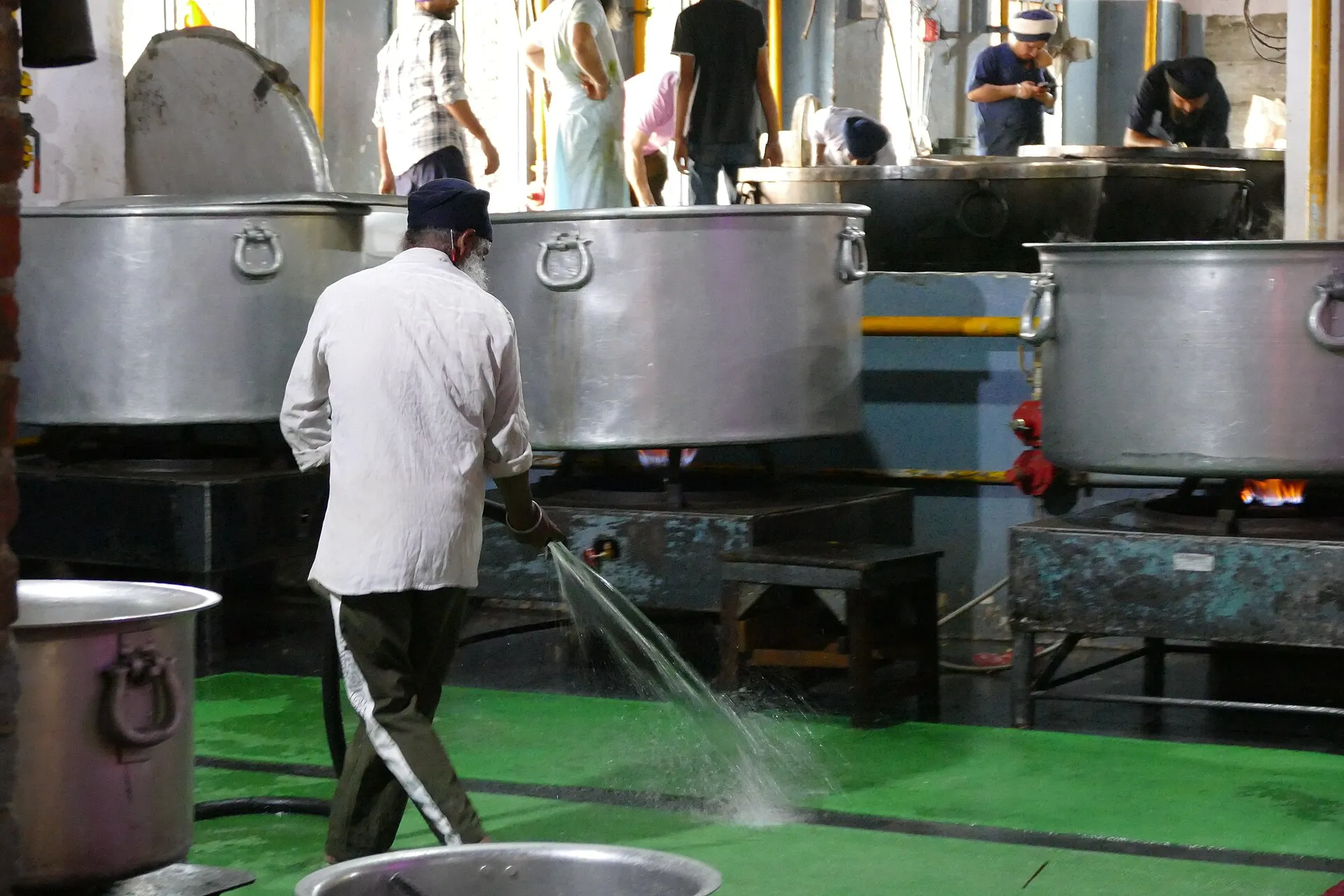
The Golden Temple’s kitchen runs every day of the year. Food is cooked in huge cauldrons, and the kitchen now runs mainly on piped gas, using about 1,300 units in 24 hours, plus around 30 LPG refills [6].
Much of the work is done by sevadars, volunteers doing seva, selfless service [7]. Visitors from Punjab, the rest of India and abroad roll rotis, chop vegetables, serve food or wash the steel plates, side by side with the regular kitchen staff.
Visiting
The Golden Temple is open to people of every faith. Visitors cover their heads, take off their shoes and wash their feet before entering. Anyone, at any hour, can walk into the langar hall, sit on the floor and share a meal.
Why it matters
The langar turns a simple idea into daily practice: share food as equals, and differences matter less. Every day, tens of thousands of strangers sit on the same floor in Amritsar and eat the same meal.
Sources
- [1] History of Sachkhand Sri Harmander Sahib — Shiromani Gurdwara Parbandhak Committee (SGPC). Accessed 11 October 2026.
- [2] Guru Arjan — Encyclopaedia Britannica. Accessed 11 October 2026.
- [3] Sikhism — Encyclopaedia Britannica. Accessed 11 October 2026.
- [4] Sri Guru Amardas Ji — Shiromani Gurdwara Parbandhak Committee (SGPC). Accessed 11 October 2026.
- [5] Guru Amar Das — Encyclopaedia Britannica. Accessed 11 October 2026.
- [6] At Golden Temple's langar, enough cooking gas supplies — The Tribune. Accessed 11 October 2026.
- [7] Langar — Encyclopaedia Britannica. Accessed 11 October 2026.
Last updated . Report a correction