The City That Travellers Compared to Rome: Discovering the Ruins of Hampi
Hampi in Karnataka was once the capital of the mighty Vijayanagara Empire. Its ruins, temples and boulders form one of India's most magical landscapes.
By IndianGaurav team ·
Picture a landscape that looks as if giants have been playing with stones. Granite boulders, some as big as houses, sit piled on one another at impossible angles. Between them flows the Tungabhadra river, past banana groves and paddy fields.
Scattered across this land are the ruins of temples, palaces, markets, gateways and royal baths. This is Hampi, in Karnataka, which five centuries ago was the capital of one of the largest and richest empires in Indian history.
UNESCO inscribed the Group of Monuments at Hampi on its World Heritage List in 1986 [1].
The rise of Vijayanagara
The city of Vijayanagara, “City of Victory”, and its first royal line were founded in 1336 [2]. The brothers Harihara and Bukka, sons of a chief named Sangama, became its first kings, and their family ruled until about 1485 [2].
Over the next two centuries the empire spread across much of southern India, and its kings built a vast capital ringed by fortification walls [1].
The golden age of Krishnadevaraya
The empire reached its height under Krishnadevaraya, who ruled from 1509 to 1529. Under him the kingdom became more powerful than ever before [3].
He was also a scholar and poet, and a great patron of Telugu and Sanskrit literature [3]. Folk tales about his witty courtier Tenali Rama are still loved by children across India.
Treasures in stone
Hampi’s surviving monuments are spread over a large area. Among the best known [1][5]:
- Virupaksha Temple. Dedicated to a form of Shiva, it is still an active place of worship, and its towering gateway overlooks the old bazaar street.
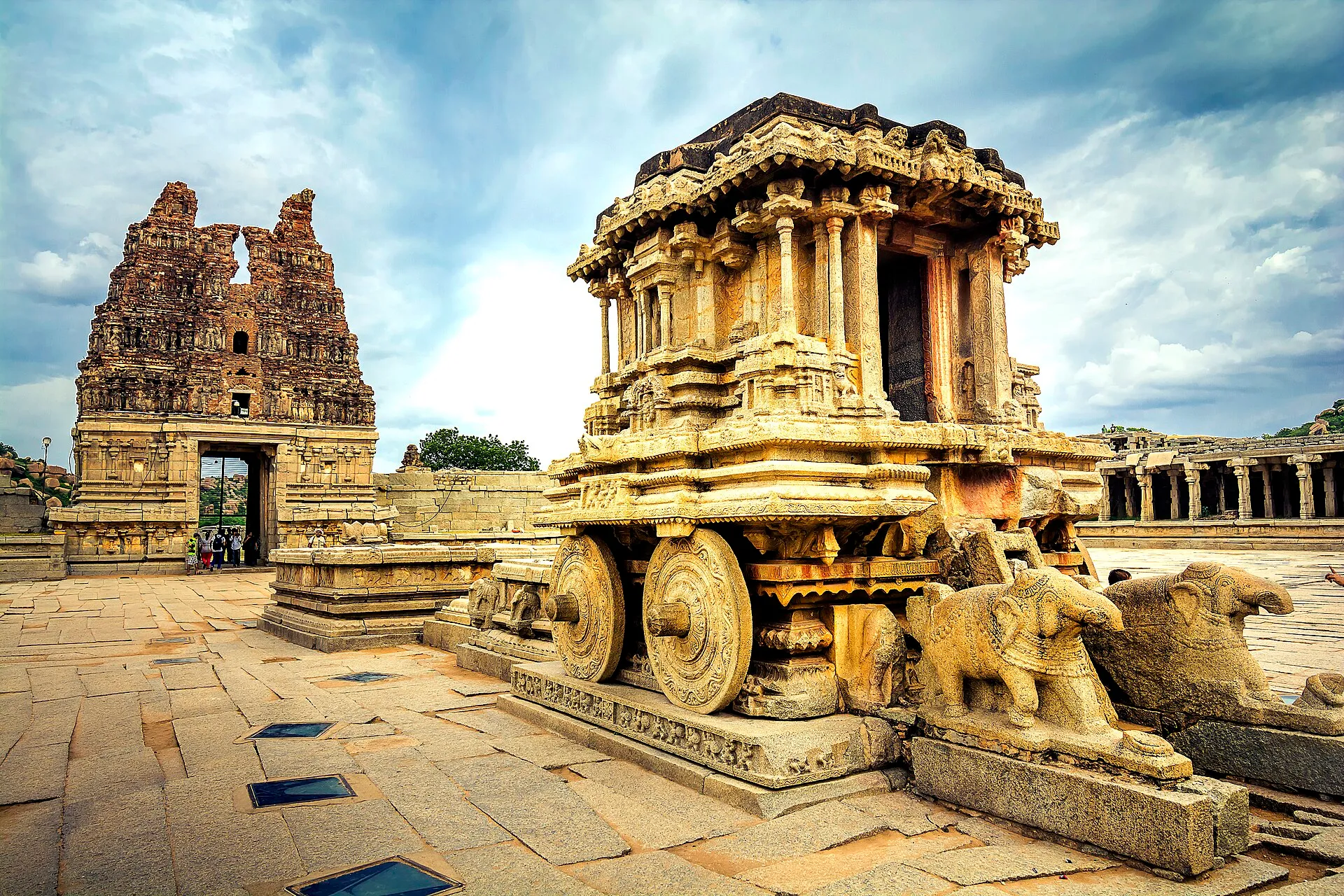
- Vittala Temple. The most richly decorated building at Hampi and the high point of Vijayanagara temple architecture [1]. Its halls are famous for musical pillars that ring with different notes when tapped [5].
- The stone chariot. In the Vittala Temple’s courtyard stands a granite shrine to Garuda, Vishnu’s eagle mount, carved in the shape of a temple chariot on stone wheels [6].
- Lotus Mahal, Elephant Stables and the Mahanavami Dibba, buildings of the royal centre where kings received guests, kept their elephants and watched festivals.
The fall of the city
In 1565, the Vijayanagara army led by Rama Raya was defeated at the Battle of Talikota by an alliance of Deccan sultanates [2]. The capital was sacked and never recovered, though the kingdom itself survived elsewhere for decades more [2].
For centuries, Hampi’s ruins lay quiet among the boulders, visited by pilgrims, shepherds and the occasional traveller.
A close call
Protecting a site this big, in a living landscape, is not easy. In 1999, UNESCO put Hampi on its List of World Heritage in Danger because two bridges being built over the Tungabhadra threatened the site, and road works had already led to the dismantling of an old pavilion [4]. After a bypass road and other safeguards, Hampi was taken off the danger list in 2006 [1].
Experiencing Hampi today
Hampi draws history lovers, pilgrims, photographers, backpackers and rock climbers. Visitors can explore by bicycle or on foot, cross the river in a round coracle boat, watch the sunset from the hills, and attend the Hampi Utsav, a festival of music, dance and drama [5].
Why it matters
Hampi shows the wealth, artistry and confidence of medieval South India. Walking among its ruins, between the boulders and the river, you can almost hear the bustle of the bazaar and the ring of the temple pillars. It is a reminder of how much of India’s past is still waiting to be explored.
Sources
- [1] Group of Monuments at Hampi — UNESCO World Heritage Centre. Accessed 11 October 2026.
- [2] Vijayanagara — Encyclopaedia Britannica. Accessed 11 October 2026.
- [3] Krishna Deva Raya — Encyclopaedia Britannica. Accessed 11 October 2026.
- [4] World Heritage Committee Adds Four Sites to the List of World Heritage in Danger — UNESCO World Heritage Centre. Accessed 11 October 2026.
- [5] Hampi — Karnataka Tourism, Government of Karnataka. Accessed 11 October 2026.
- [6] Stone Chariot — Karnataka Tourism, Government of Karnataka. Accessed 11 October 2026.
Last updated . Report a correction