Stone So Soft It Could Be Carved Like Lace: The Hoysala Temples of Karnataka
The star-shaped Hoysala temples of Belur, Halebidu and Somanathapura are famed for their intricate carvings. UNESCO listed them in 2023.
By IndianGaurav team ·
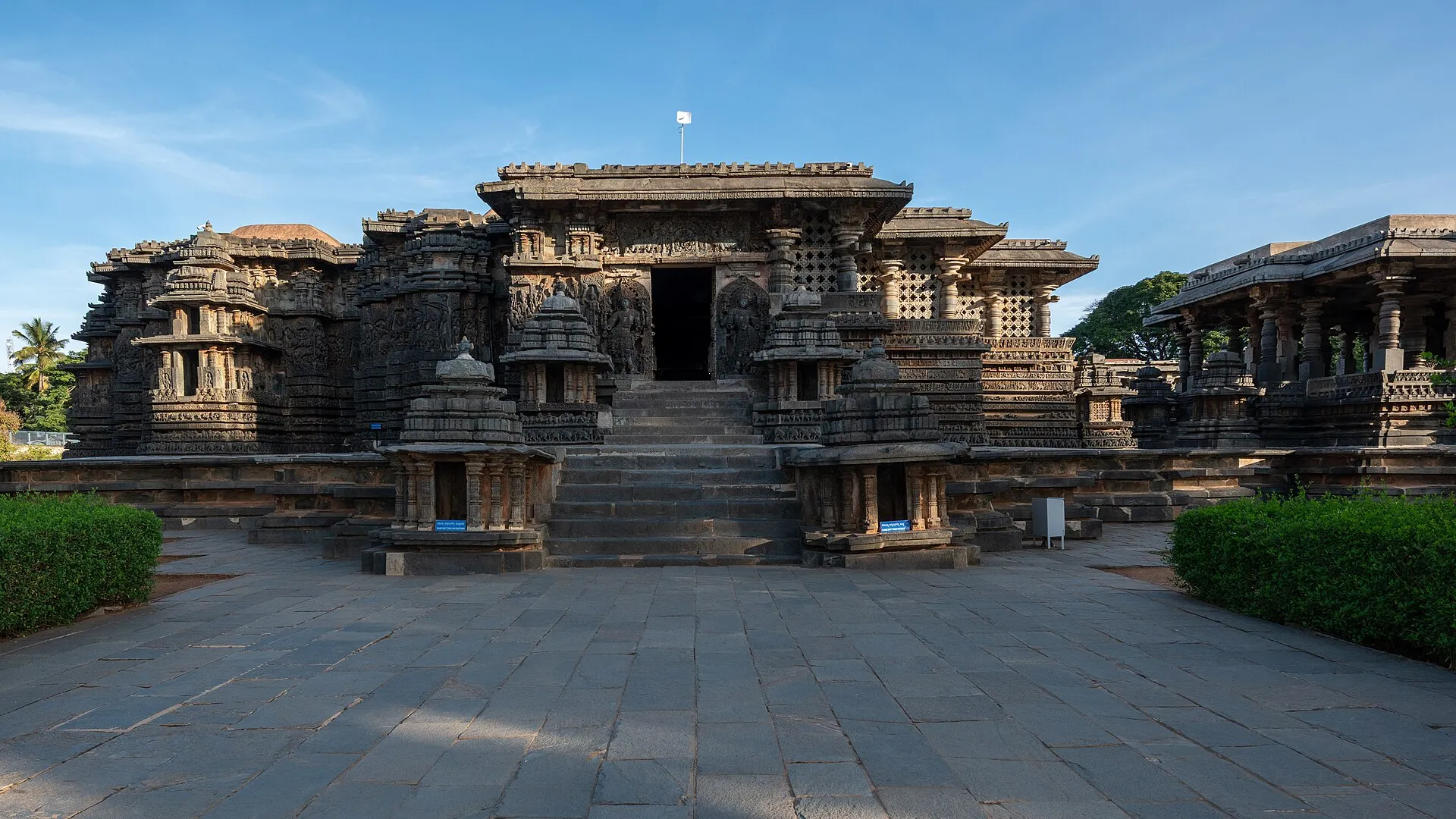
Look closely at the walls of a Hoysala temple in Karnataka and it is hard to believe they are stone. Dancers seem to move, jewellery seems to hang loose, and leaves and flowers are carved as finely as lace. Every surface tells a story.
These temples were built by the Hoysala dynasty in the 12th and 13th centuries. In September 2023, UNESCO added three of them to its World Heritage List as the Sacred Ensembles of the Hoysalas [1]:
- the Chennakeshava Temple at Belur
- the Hoysaleswara Temple at Halebidu
- the Keshava Temple at Somanathapura
They became India’s 42nd World Heritage Site [2].
Who were the Hoysalas?
The Hoysalas ruled in the southern Deccan from about 1006 to 1346 CE [3]. Their capital, Dorasamudra, beside a great man-made lake, is today’s Halebidu [3][4].
A favourite Hoysala image shows a young man named Sala fighting a tiger, a scene carved at Belur and linked to the dynasty’s origin story [3].
A style of their own
Hoysala temples are easy to recognise. Most stand on a raised platform that visitors walk around, and their walls follow a star-shaped plan with many sharp corners and projections [1][6]. UNESCO singles out this combination of star-shaped plan, platform and layered friezes, with sculpture covering almost every surface, as what makes them unique [1].
The sculptors worked in soapstone, a fine-grained stone that allowed extraordinarily detailed carving [5][6].
Belur: the Chennakeshava Temple
The Chennakeshava Temple at Belur, dedicated to Vishnu, has been a place of worship since 1117 CE [1]. It is still an active temple today.
Its walls are carved with stories from the Ramayana and Mahabharata, and it is famous for its madanikas, graceful figures of celestial dancers [5].
Halebidu: the Hoysaleswara Temple
Halebidu and Belur were once twin centres of Hoysala power, both in today’s Hassan district [5]. At Halebidu, the Hoysaleswara Temple, dedicated to Shiva, has friezes and figures carved so endlessly that no two seem alike [5].
The city’s wealth made it a target. It was sacked twice by armies from the north, in 1311 and 1326, and declined afterwards [4]. Much of the temple’s beauty survived.
Somanathapura: the Keshava Temple
The Keshava Temple at Somanathapura, about 35 km from Mysuru, was built in 1268 CE by Somanatha Dandanayaka, a commander under King Narasimha III [6]. It has three shrines on a raised, star-shaped platform [6], and UNESCO describes it as the last major temple built in the Hoysala style [1].
Visiting the Hoysala temples
Belur and Halebidu are close together in Hassan district and are easy to visit on the same day. Somanathapura makes a short trip from Mysuru [5][6]. Allow plenty of time: the beauty of these temples is in the detail, and the best way to enjoy them is to walk slowly around the platform and look closely.
Why it matters
The Hoysala temples show the skill and imagination of medieval Indian artists, who turned stone into something that seems almost alive. Eight hundred years later, they still astonish visitors from around the world, a reminder that India’s artistic heritage is delicate as well as grand.
Sources
- [1] Sacred Ensembles of the Hoysalas — UNESCO World Heritage Centre. Accessed 11 October 2026.
- [2] PM Modi praises inclusion of Karnataka's Sacred Ensembles of Hoysalas in UNESCO World Heritage List — News On AIR (All India Radio). Accessed 11 October 2026.
- [3] Hoysala dynasty — Encyclopaedia Britannica. Accessed 11 October 2026.
- [4] Halebid — Encyclopaedia Britannica. Accessed 11 October 2026.
- [5] Halebeedu & Belur: The Twin Temples of Hoysala Grandeur — Karnataka Tourism, Government of Karnataka. Accessed 11 October 2026.
- [6] Somanathpura Temple, Mysore — Karnataka Tourism, Government of Karnataka. Accessed 11 October 2026.
Last updated . Report a correction