Nothing Changed Everything: How India Gave the World Zero
The idea of zero as a number, and the decimal place-value system we all use, grew out of ancient India. Here is how it happened.
By IndianGaurav team ·
Try writing the number one thousand without a zero. Or one hundred and five. Or a phone number, a bank balance, a cricket score of 100.
You can’t. Not easily. And yet, for most of human history, people around the world managed without zero as we know it. They used words, special symbols for large numbers, or simply left a gap.
The idea that “nothing” could be written down as a symbol, used in sums like any other number, and placed in a row of digits to change their value, is one of the most powerful ideas humanity ever had. And it developed in ancient India [2][4].
Two big ideas
When people say India “invented zero”, they are really talking about two linked ideas.
The first is place value. In our system, the position of a digit tells you its value. In 222, the first 2 means two hundred, the second means twenty, and the last means two. Only ten symbols, 0 to 9, are needed to write any number, however large.
The second is zero as a number. In a place-value system, you need something to show an empty place. In 205, the 0 tells you there are no tens. But Indian mathematicians went further. They treated zero not just as a placeholder but as a number in its own right, with its own rules for adding, subtracting and multiplying [2][4].
Together, these ideas form the decimal place-value system, the foundation of all modern arithmetic, science, engineering and computing.
Shunya: the meaning of emptiness
In Sanskrit, zero was called shunya, meaning “empty” or “void”. The concept of emptiness was already important in Indian philosophy. Some historians think this comfort with the idea of “nothing” may have helped Indian thinkers accept it as a mathematical quantity [4].
In early Indian writing, zero was often shown as a dot. Over time, the dot became a small circle, which is the shape we still use today.
The Bakhshali manuscript
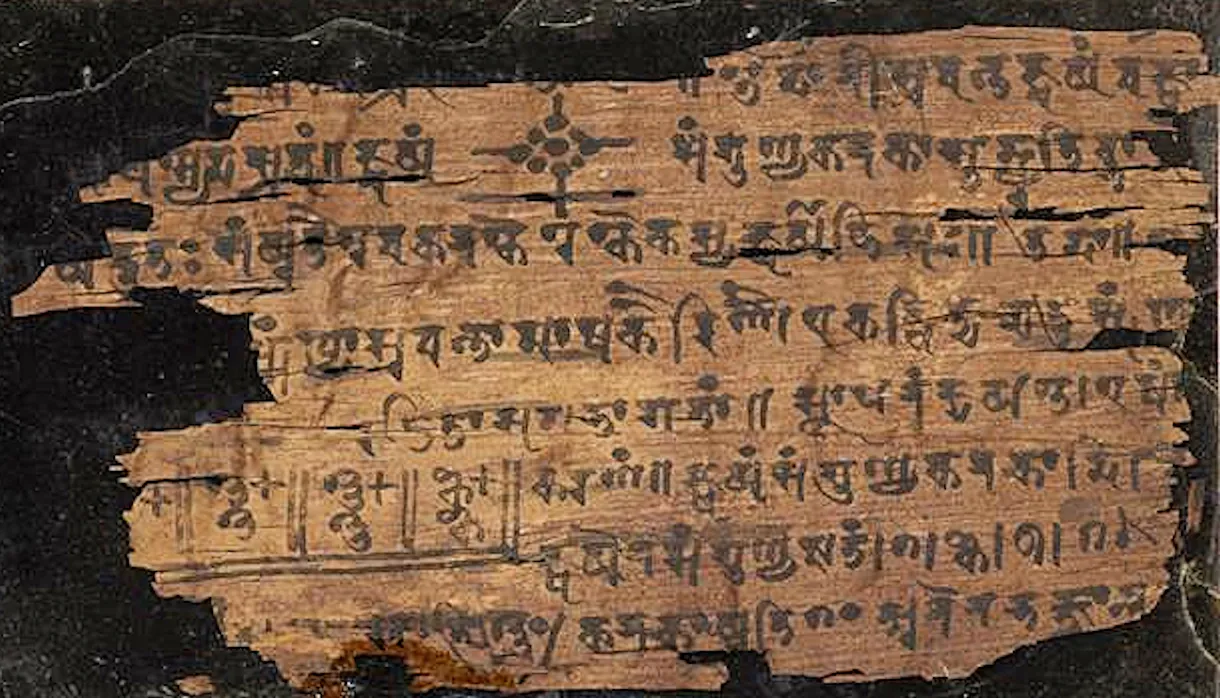
One of the oldest surviving examples of a zero symbol is found in the Bakhshali manuscript, a mathematical text written on birch bark. It was found in 1881, buried in a field near the village of Bakhshali, in what is now Pakistan, and is kept at the Bodleian Library at the University of Oxford [1].
The manuscript uses hundreds of dots as zeros. In 2017, researchers at Oxford used carbon dating to study its age. The results suggested that some of its pages date back to the 3rd or 4th century CE, centuries earlier than scholars had previously believed [1]. That would make its dot one of the earliest known written zeros in the world.
Aryabhata: the great astronomer
Aryabhata was one of ancient India’s greatest mathematicians and astronomers. Born in 476 CE, he wrote his famous work, the Aryabhatiya, in 499 CE, when he was just 23 years old [3]. He is associated with Kusumapura, near present-day Patna.
Aryabhata worked with a place-value system and used it for complex calculations. He gave a very accurate value for pi, explained that the Earth rotates on its axis, and correctly described the cause of solar and lunar eclipses [3].
Centuries later, India named its first satellite Aryabhata, launched in 1975, in his honour [3].
Brahmagupta: the rules of zero
The person who first wrote down clear rules for doing arithmetic with zero was Brahmagupta. Born in 598 CE, he worked in the region of present-day Rajasthan and Gujarat [2].
In 628 CE, he completed a major work called the Brahmasphutasiddhanta. In it, he set out rules such as [2][4]:
- A number plus zero gives the same number.
- A number minus zero gives the same number.
- A number multiplied by zero gives zero.
He also wrote rules for working with negative numbers, which he described as “debts”, alongside positive numbers or “fortunes”. This was a remarkable step. Many mathematicians elsewhere did not accept negative numbers for centuries afterwards.
Brahmagupta also tried to define what happens when you divide by zero. His answer was not the one modern mathematicians use, but the fact that he asked the question shows how seriously he treated zero as a real number.
How the idea travelled the world
Indian numerals and the decimal system spread westwards through trade and scholarship.
Scholars in the Arab world translated Indian mathematical and astronomical texts. In the 9th century, the Persian mathematician al-Khwarizmi wrote a book on calculating with Indian numerals. His name later gave us the word “algorithm” [4].
From the Arab world, these numerals reached Europe. In 1202, the Italian mathematician Fibonacci published a book promoting the “Indian method” of calculation. Over the following centuries, Europe gradually switched from Roman numerals to the new system [4].
That is why the digits we use today are often called Hindu-Arabic numerals, a name that records their Indian origin and the Arab world’s role in passing them on [4].
Why it matters today
It is hard to overstate how important zero and the decimal system are.
Without them, modern mathematics, accounting, banking, physics and engineering would be far harder. Computers run on a binary system of just two digits, 0 and 1. Every digital photo, message and payment depends, at its root, on a way of thinking about numbers that grew from Indian ideas.
A gift to humanity
India’s contribution to mathematics goes far beyond zero. Indian scholars made major advances in algebra, trigonometry and the early ideas of calculus. The Kerala school of mathematics, for example, worked on infinite series centuries before similar results appeared in Europe.
But zero holds a special place. It is a perfect example of how a simple-looking idea, born of deep thinking, can change the world.
The next time you see a zero on a price tag, a scoreboard or a screen, remember that it carries a story more than 1,500 years old, written in birch bark and Sanskrit verse, by Indian minds who dared to treat nothing as something.
Sources
- [1] Carbon dating reveals earliest origins of zero symbol — University of Oxford. Accessed 11 October 2026.
- [2] Brahmagupta — Encyclopaedia Britannica. Accessed 11 October 2026.
- [3] Aryabhata — Wikipedia. Accessed 11 October 2026.
- [4] 0 — Wikipedia. Accessed 11 October 2026.
Last updated . Report a correction