Carved From the Top Down: How Ancient Builders Cut a Temple Out of a Mountain
The Kailasa Temple at Ellora was carved from a single mass of rock in the 8th century. It is one of the greatest feats of rock-cut architecture anywhere.
By IndianGaurav team ·
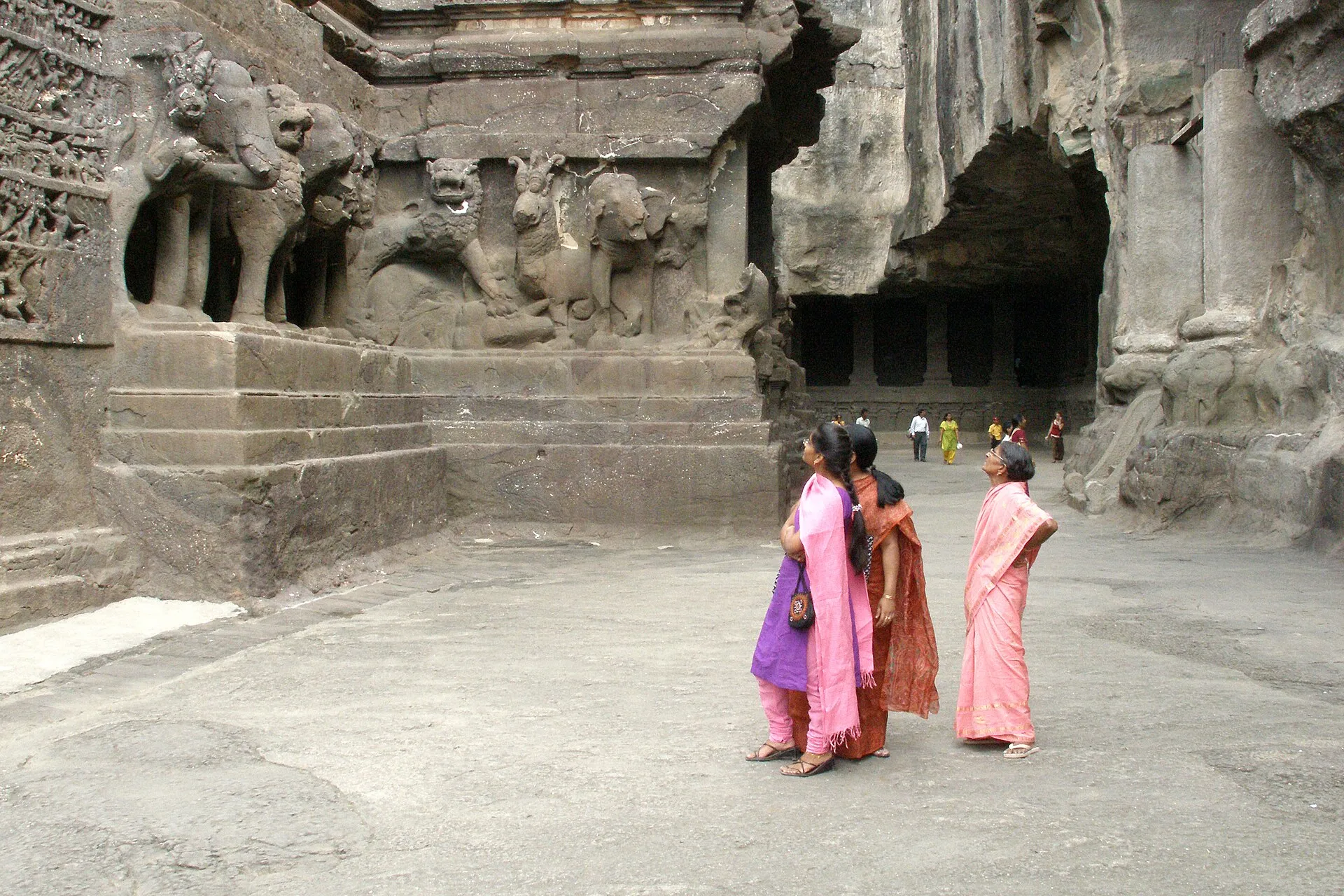
Most buildings are made by putting things together: stone on stone, brick on brick. The Kailasa Temple at Ellora was made the other way round. Its builders started with a hillside of solid rock and cut away everything that was not the temple.
The result is a multi-storey temple with towers, halls, pillars, a bridge, life-size elephants and countless carved figures, all cut from one mass of basalt. The Archaeological Survey of India calls it the “largest single monolithic excavation in the world” [2].
The Kailasa Temple is the crown of the Ellora Caves in Maharashtra, about 30 km from Chhatrapati Sambhajinagar (formerly Aurangabad) [2]. UNESCO inscribed Ellora on its World Heritage List in 1983 [1].
Thirty-four caves, three faiths
Ellora is far more than one temple. Along the cliff are 34 caves: numbers 1 to 12 are Buddhist, 13 to 29 Hindu, and 30 to 34 Jain [2]. UNESCO describes them as an unbroken sequence of monuments from about 600 to 1000 CE [1], and the ASI notes that Buddhist and Hindu caves were carved side by side under the same rulers, a sign of the religious tolerance of the age [2].
The Rashtrakuta masterpiece
The Kailasa Temple, Cave 16, is attributed to the Rashtrakuta king Krishna I, who ruled in the second half of the 8th century [2][3]. A copper-plate grant from about 812 CE already praised the building as a wonder [2].
It is dedicated to Shiva and named after Mount Kailasa, his mountain home in the Himalayas [3].
Carved from the top down
Most cave temples at Ellora were cut straight into the face of the cliff. The Kailasa was different: it was excavated downwards from the top of the hill [3]. The builders cut deep trenches around a huge block of rock and then shaped the temple inside it, from the tower downwards.
Britannica estimates that some 150,000 to 200,000 tonnes of rock were removed [3]. The temple that remains is about 50 metres long, 33 metres wide and 30 metres high, rising through four levels [3]. Every cut was permanent: if a sculptor took away too much, it could not be put back.
What you see inside
- Two huge stone elephants stand in the courtyard, beside two monolithic victory pillars about 45 feet tall, crowned with Shiva’s trident [5].
- The temple’s base is carved with a frieze of elephants, lions and mythical animals [5], and life-size elephants appear along the walls [3].
- A Nandi pavilion, for Shiva’s bull, stands between the gateway and the main shrine, joined to it by a stone bridge [5].
- One of the most famous panels shows the demon king Ravana trying to lift Mount Kailasa, Shiva’s home [3][4].
Ellora and Ajanta
Ellora is often visited together with the Ajanta Caves, also a World Heritage Site since 1983 and famous for its Buddhist paintings. Ellora is renowned for sculpture and architecture.
Visiting Ellora
The caves are open from sunrise to sunset and closed on Tuesdays [2]. Allow at least half a day; the Kailasa Temple alone can take hours. From the path above the temple you can look down into the courtyard and see how the whole building was cut out of the hill.
Why it matters
The Kailasa Temple is one of humanity’s great artistic and engineering achievements: the vision, planning and skill of builders who lived more than 1,200 years ago. It stands on a cliff where Buddhist, Hindu and Jain monuments sit side by side, a reminder of India’s long tradition of different faiths creating together.
Sources
- [1] Ellora Caves — UNESCO World Heritage Centre. Accessed 11 October 2026.
- [2] Ellora Caves — Archaeological Survey of India. Accessed 11 October 2026.
- [3] Kailasa — Encyclopaedia Britannica. Accessed 11 October 2026.
- [4] Periodic Report on the State of Conservation of Ellora Caves — UNESCO World Heritage Centre. Accessed 11 October 2026.
- [5] Ellora Caves — Brahmanical group of caves — Archaeological Survey of India. Accessed 11 October 2026.
Last updated . Report a correction