Back From the Brink: How Kaziranga Saved the One-Horned Rhino
Kaziranga in Assam is home to about two-thirds of the world's greater one-horned rhinos, a remarkable conservation success.
By IndianGaurav team ·
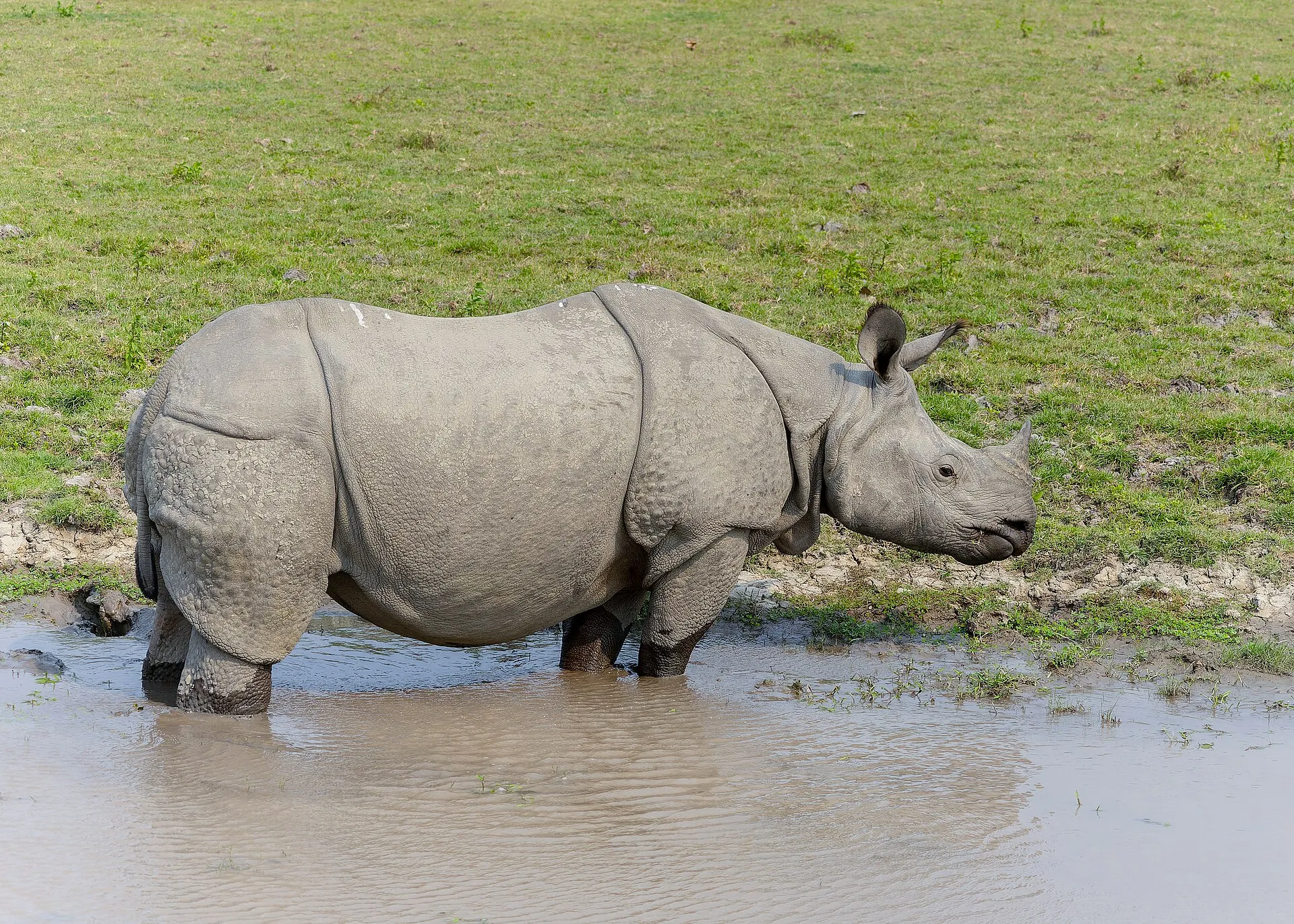
At the start of the 20th century, the greater one-horned rhinoceros was close to disappearing. Hunted for sport and for its horn, and pushed out of its grassland home by farming, only a small number were believed to survive in the floodplains of Assam [3].
Today, a single national park in Assam is home to around two-thirds of all greater one-horned rhinos in the world [1][3]. That park is Kaziranga, and its story is one of India’s great conservation successes.
A park on the Brahmaputra
Kaziranga lies on the southern bank of the mighty Brahmaputra river, in the Golaghat, Nagaon and Biswanath districts of Assam. It is a landscape of tall elephant grass, marshes, shallow lakes called beels, and patches of tropical forest, all shaped by the river [1].
Every year, the monsoon floods sweep across much of the park. The floods are dangerous for animals, but they are also what keeps the grasslands fertile and the wetlands alive. Kaziranga exists because of this yearly cycle of water.
How protection began
Kaziranga’s story as a protected area began over a century ago. In 1904, Mary Curzon, wife of the then Viceroy of India, Lord Curzon, visited the area hoping to see a rhino. She saw only hoof prints. Worried about the animal’s survival, she is said to have urged her husband to protect the region [3].
In 1905, Kaziranga was declared a proposed reserve forest. Over the following decades its protection was steadily increased: it became a game sanctuary, then a wildlife sanctuary, and in 1974 it was declared a national park [3]. In 1985, UNESCO recognised it as a World Heritage Site, describing it as one of the last areas in eastern India undisturbed by people and home to the world’s largest population of the greater one-horned rhino [1]. In 2006, it was also declared a tiger reserve [2][3].
Counting rhinos
From a few dozen at the start of the 20th century, Kaziranga’s rhino population has grown dramatically. The park’s 2022 census counted 2,613 rhinos, up 200 from 2,413 in 2018 [2]. Together with smaller populations elsewhere in Assam, in West Bengal, and in Nepal, this means the species has been pulled back from the brink.
The greater one-horned rhino is a huge, grey, armour-plated animal that can weigh more than two tonnes. Despite its bulk, it is mostly peaceful, spending its days grazing on grass and wallowing in mud and water to keep cool.
The guardians of Kaziranga
This recovery did not happen by chance. It was the result of decades of hard, dangerous work by forest guards, officers and local communities.
Poachers have long targeted rhinos for their horns, which are wrongly believed in some countries to have medicinal value and fetch very high prices on illegal markets. In some years, dozens of rhinos were killed in and around Kaziranga.
In response, Assam built up a dedicated anti-poaching force. Forest guards live in camps spread across the park and patrol on foot, by elephant and by boat, in heat, rain and floods [3].
Over time, better intelligence, technology such as drones and cameras, stronger laws, and community support helped bring poaching down sharply. In recent years, Assam has reported years with very few or no rhino poaching cases in Kaziranga, a remarkable turnaround [3].
More than rhinos
The rhino is Kaziranga’s star, but the park is home to much more. It is often said to host the “Big Five” of Indian wildlife [1][3]:
- Greater one-horned rhinoceros
- Royal Bengal tiger, with one of the highest tiger densities of any protected area in the world
- Asian elephant
- Wild water buffalo, whose largest population is found here
- Eastern swamp deer
The park is also a paradise for birdwatchers, with hundreds of bird species, including migratory birds that arrive in winter [3]. Rivers and wetlands hold otters, turtles and even the rare Gangetic river dolphin in nearby stretches of the Brahmaputra.
Living with the floods and the highway
Kaziranga faces real challenges. During the monsoon, floods force animals to move to higher ground, including hills to the south of the park. To get there, they must cross a busy national highway. Animal deaths on this road used to be common. Authorities now limit vehicle speeds during floods to help animals cross safely [3].
Artificial highlands built inside the park give animals places to escape the rising water. Rescue centres, run with conservation groups, care for injured and orphaned animals, including rhino calves separated from their mothers in floods.
Visiting Kaziranga
Kaziranga is divided into several tourist ranges, each with its own character. Most visitors explore by open jeep, and morning elephant rides are offered in some areas. The park usually opens to tourists in the cooler, drier months after the monsoon and closes during the flood season, when the animals need to be left in peace.
Visitors are asked to follow simple rules: stay inside vehicles, keep noise low, never feed animals and never leave plastic behind. Tourism also gives communities around the park a stake in keeping its wildlife safe.
A model for the world
Kaziranga’s success has inspired conservation efforts elsewhere. Rhinos from Assam have been moved to other protected areas, such as Manas National Park, to build new populations and reduce the risk of keeping all of them in one place [3].
For visitors, Kaziranga offers one of the most memorable wildlife experiences in Asia. A jeep or elephant safari at dawn, when mist hangs over the grasslands and a rhino slowly lifts its head to look at you, stays with people for a lifetime.
Why India can be proud
In a world where many species are declining, Kaziranga is proof that the trend can be reversed. It shows what is possible when government, forest staff, scientists and local communities work together, over many decades, with patience and courage.
The next time you see a picture of a one-horned rhino, remember that it is very likely a survivor of a story written in Assam, by people who decided that this ancient animal deserved a future.
Sources
- [1] Kaziranga National Park — UNESCO World Heritage Centre. Accessed 11 October 2026.
- [2] Assam rhino population jumps by 200 at Kaziranga — EastMojo (PTI). Accessed 12 October 2026.
- [3] Kaziranga National Park — Wikipedia. Accessed 11 October 2026.
Last updated . Report a correction