66 Crore Pilgrims, One River Bank: Inside the Largest Gathering on Earth
The Kumbh Mela is recognised by UNESCO as the world's largest peaceful gathering of pilgrims. The 2025 Maha Kumbh drew over 66 crore devotees.
By IndianGaurav team ·
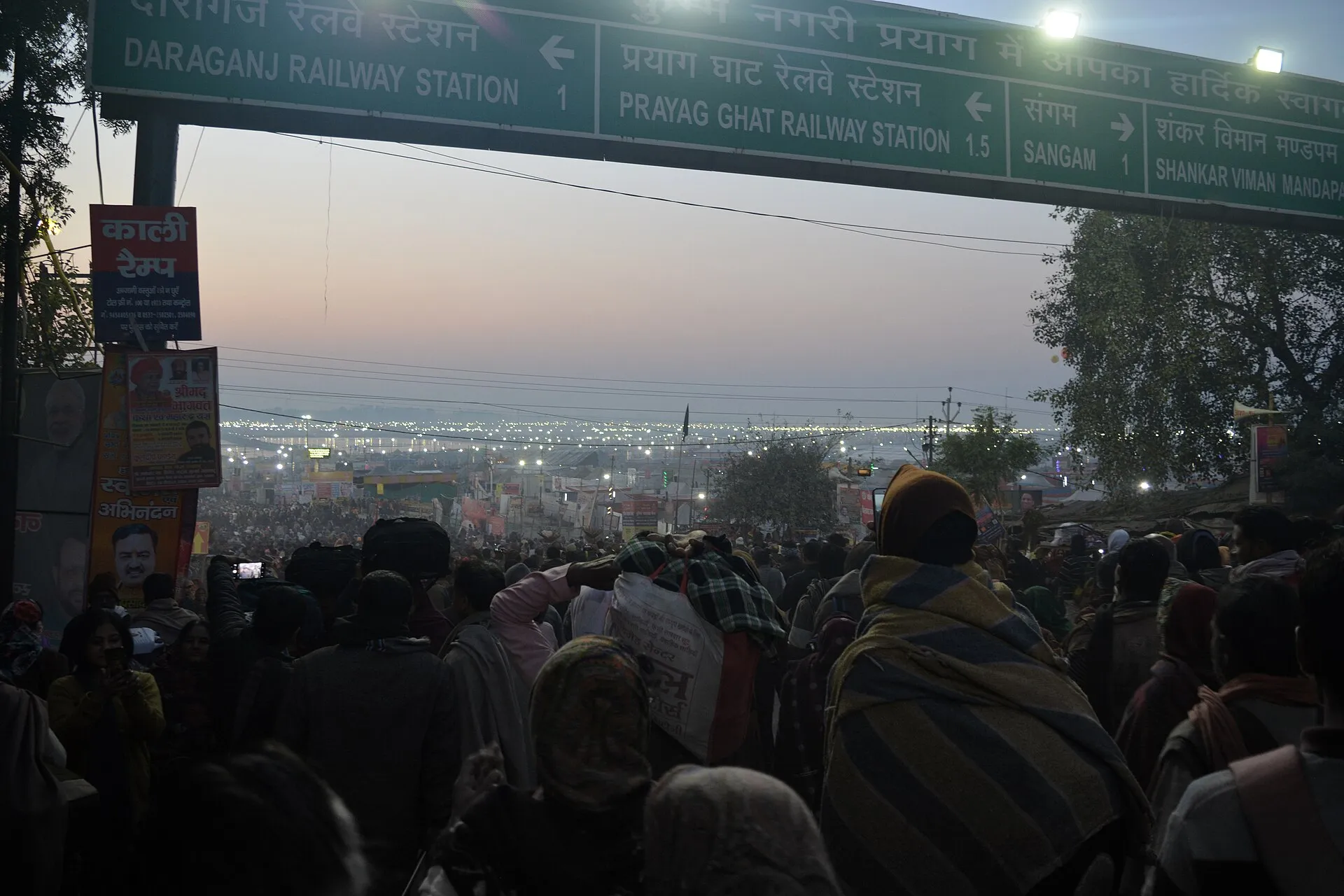
Imagine a temporary city that appears on a riverbank, grows larger than most countries, and then quietly disappears a few weeks later. It has its own roads, bridges, hospitals, police stations, power lines, water supply and sanitation. It hosts saints and scientists, farmers and foreign tourists, the very poor and the very rich. And almost everyone who comes is there for the same simple reason: to take a holy dip.
That is the Kumbh Mela. In 2017, UNESCO added it to its list of the Intangible Cultural Heritage of Humanity, describing it as “the largest peaceful congregation of pilgrims on earth” [1].
Where the story begins
The Kumbh Mela is rooted in a Hindu legend about the churning of the ocean, the Samudra Manthan. In the story, gods and demons churned the cosmic ocean to obtain amrit, the nectar of immortality. When the pot (kumbh) of nectar emerged, a struggle broke out, and a few drops fell to Earth at four places [3].
Those four places became the sites of the Kumbh Mela [3]:
- Prayagraj (Uttar Pradesh), at the Triveni Sangam, where the Ganga and Yamuna meet, along with the mythical Saraswati.
- Haridwar (Uttarakhand), on the Ganga.
- Ujjain (Madhya Pradesh), on the Shipra.
- Nashik (Maharashtra), on the Godavari.
The festival rotates among these cities, with the timing set by the positions of Jupiter, the Sun and the Moon. At each site a Kumbh is held roughly every 12 years, with smaller gatherings in between [3]. The very largest, the Maha Kumbh, is held at Prayagraj.
Faith in the water
At the heart of the Kumbh is a ritual bath. Pilgrims believe that bathing in the sacred river at an auspicious time washes away sins and brings spiritual merit. On the most important bathing days, known as Amrit Snan (earlier called Shahi Snan), the crowds are at their largest [3].
These days begin with grand processions of sadhus and spiritual orders, called akharas. Ascetics with ash-smeared bodies, holy men on elephants and horses, and saints carried on decorated chariots make their way to the river amid chanting, drums and conch shells. For many visitors, the akhara processions are one of the most unforgettable sights in India [3].
But the Kumbh is not only about bathing. It is also a vast meeting place for spiritual teaching. Thousands of camps host talks, prayers, music and community kitchens. Many pilgrims spend weeks living simply by the river, a practice called kalpvas [3].
The Maha Kumbh of 2025
The Maha Kumbh held at Prayagraj from 13 January to 26 February 2025 drew numbers that are hard to imagine [2].
Over 45 days, the Uttar Pradesh government reported that more than 66 crore (660 million) devotees took a dip at the Triveni Sangam [2]. To put that in perspective, that is more people than live in every country in the world except India and China. Mauni Amavasya, on 29 January, was the most auspicious bathing day of the festival [4].
The festival ground was spread over thousands of hectares of riverbed, divided into sectors, each with its own administration. Organisers built pontoon bridges across the river, laid temporary roads, set up tent cities and arranged lakhs of toilets. Indian Railways ran special trains, and new temporary hospitals and police stations were set up throughout the site [3].
Running such an event is never without difficulty. In the early hours of Mauni Amavasya, crowds broke through barricades near the Sangam, and at least 30 people were killed and 60 injured in the crush that followed [4]. It was a painful reminder of how hard it is to keep such vast numbers safe, and of why crowd management matters so much at events like this.
A meeting place for all of India
What makes the Kumbh special is how it brings people together. On the riverbank, a farmer from Bihar may stand next to a software engineer from Bengaluru, a widow from Bengal, a family from Gujarat and a visitor from Japan. Languages, castes, regions and incomes blur into one stream of people moving towards the water.
UNESCO, in its recognition, pointed out that the Kumbh is attended by people without any discrimination, and that knowledge and skills linked to it are passed on through teacher-student relationships among saints and sadhus [1]. Its rituals, chants and traditions have been handed down over centuries.
A puzzle for the world’s scientists
The Kumbh has also become a subject of serious study. Researchers from universities in India and abroad have examined it as a model of temporary city planning, crowd management, public health and sanitation. How do you provide clean drinking water to millions? How do you prevent disease outbreaks? How do you guide crowds safely to the river and back?
Each Kumbh has to solve these problems again, at an ever larger scale [3].
Old roots, new technology
Ancient travellers wrote about great gatherings at Prayag. The Chinese pilgrim Xuanzang, who visited India in the 7th century, described a huge religious assembly at the meeting of the rivers, which many historians link to the tradition that became the Kumbh [3].
Today the same tradition continues alongside modern tools for planning and crowd management. The faith is old. The tools are new.
Why it makes India proud
The Kumbh Mela shows something about India that is hard to describe in words. It shows a civilisation that has kept a living tradition going for centuries. It shows the ability to organise on a scale that few countries could attempt. And it shows ordinary people, in their crores, choosing to come together in faith.
You do not have to be religious to be moved by it. Standing on the banks of the Sangam at dawn, watching the mist lift over an ocean of people walking calmly to the river, is to witness something no other place on Earth can offer.
Sources
- [1] Kumbh Mela — Representative List of the Intangible Cultural Heritage of Humanity — UNESCO. Accessed 11 October 2026.
- [2] 66.21 crore devotees in Maha Kumbh set global record — The Morung Express (IANS). Accessed 11 October 2026.
- [3] Kumbh Mela — Wikipedia. Accessed 11 October 2026.
- [4] 30 dead in Maha Kumbh stampede — The Tribune. Accessed 12 October 2026.
Last updated . Report a correction