Bridges That Grow: Meghalaya's Living Root Bridges and the People Who Shape Them
In Meghalaya, Khasi communities grow bridges from the roots of rubber trees over generations. In 2022 they were added to UNESCO's tentative list.
By IndianGaurav team ·
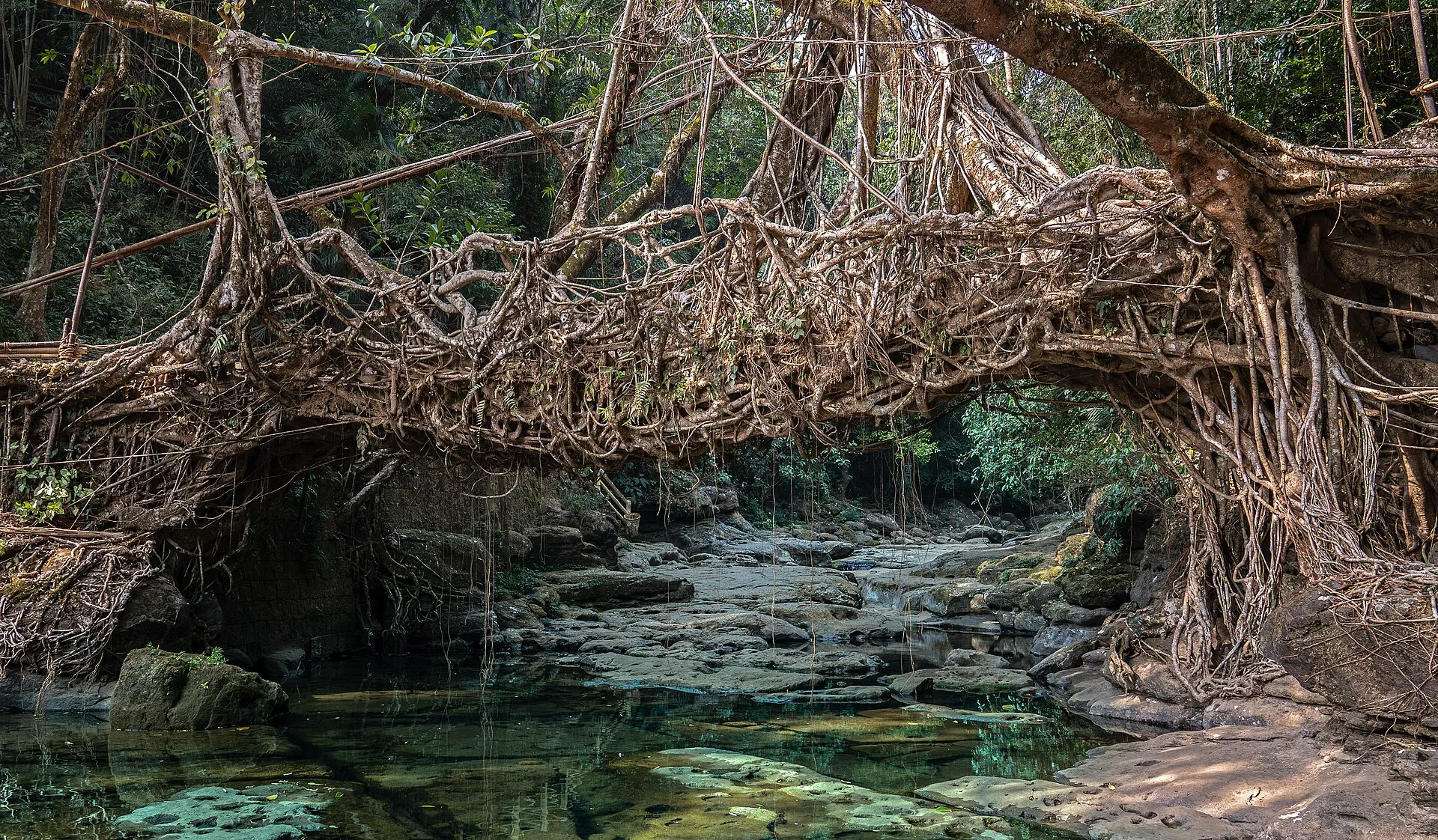
Most bridges start wearing out the day they are finished. Steel rusts, concrete cracks, wood rots.
In the hills of Meghalaya, some bridges do the opposite: they get stronger every year. These are the living root bridges, called jingkieng jri in the Khasi language. They are not built so much as grown, by guiding the roots of fig trees across streams until they form a path people can walk on [1][3].
An answer to the rain
Meghalaya’s southern hills are among the wettest places on Earth. In the monsoon, small streams become torrents, and timber rots quickly in the constant damp.
The Khasi people found an answer in the Indian rubber fig (Ficus elastica). The tree throws out long aerial roots that keep growing, and the Khasi learned those roots could be trained [3].
How a root bridge is grown
Mongabay India describes how it is done [3]:
- A rubber fig grows on the bank of a stream.
- Young roots are fed through hollowed-out trunks of areca palm, which guide and protect them, with bamboo scaffolding for support.
- Two or three long roots are stretched across the stream and anchored on the far side, in the ground or woven into another fig tree.
- Over the years, more roots are grafted in to form steps and handrails, and stones, planks and soil fill the gaps.
Roots that touch slowly fuse together, so the bridge thickens as the tree grows. Villagers say it takes 10 to 15 years before a new bridge is ready to use [2]. In time it can take heavy loads and stand without any bamboo at all [3]. A bridge started by one generation is often finished by the next.
How many are there?
A 2019 mapping by the Technical University of Munich counted 75 living root bridges, the longest about 53 metres, at Mawkyrnot [3]. Other counts put the number at around 100 bridges across more than 70 villages [2]. UNESCO’s listing names more than 75 villages where the Khasi grow these structures, including ladders and platforms as well as bridges [1].
On the road to World Heritage
In February 2022, India added the root bridges to UNESCO’s tentative list of World Heritage Sites as Jingkieng jri: Living Root Bridge Cultural Landscapes [1][2]. The listing covers not just the bridges but the whole landscape around them: the forests, streams, villages and the knowledge passed down by the people who grow them.
In January 2026, India sent UNESCO a full nomination for the landscape, the next step towards World Heritage status [4].
What the world is learning
Researchers have taken notice. Ferdinand Ludwig, a professor at the Technical University of Munich, works on Baubotanik, building with living trees, and has studied the Khasi bridges. In 2022 his team and North Eastern Hill University grew a small living-root pavilion on the university’s Shillong campus [3].
Ludwig is careful about what the bridges can teach: living roots will not replace steel, he says, but fig-based structures could help make tropical cities greener and more resilient [3].
Protecting a living heritage
The bridges face real pressures. Concrete reinforcements and paved paths are creeping in, tourist facilities are going up nearby, and some bridges are neglected as concrete crossings spread [3]. Local heritage committees have mapped more than 130 bridges and proposed a protected strip of forest around each one [3].
Visitors can help: walk carefully, don’t climb on the roots, carry litter back out, and hire local guides so that the villages caring for the bridges benefit.
Why it matters
Long before “sustainable design” was a phrase, Khasi communities worked out a way of building that uses almost no materials, repairs itself and improves with age. The living root bridges are proof that some of the world’s most remarkable engineering comes from patient communities who know their land.
Sources
- [1] Jingkieng jri: Living Root Bridge Cultural Landscapes — UNESCO World Heritage Centre (Tentative List). Accessed 11 October 2026.
- [2] Meghalaya root bridges in UNESCO's tentative list of World Heritage Sites — EastMojo. Accessed 11 October 2026.
- [3] Rooted in tradition, nature-based architecture bridges generations — Mongabay India. Accessed 11 October 2026.
- [4] List of nominations received by 30 January 2026 — UNESCO World Heritage Centre. Accessed 11 October 2026.
Last updated . Report a correction