Cheaper Than a Hollywood Film: How India Reached Mars on Its First Try
In 2014, India became the first country to reach Mars orbit on its first attempt, and the first Asian nation to get there at all.
By IndianGaurav team ·
Getting to Mars is hard. Getting there on your first attempt is harder still.
Many of the missions sent to Mars before 2014 had failed, some at launch, some on the way and some on arrival. Even the world’s most experienced space agencies had stumbled [2].
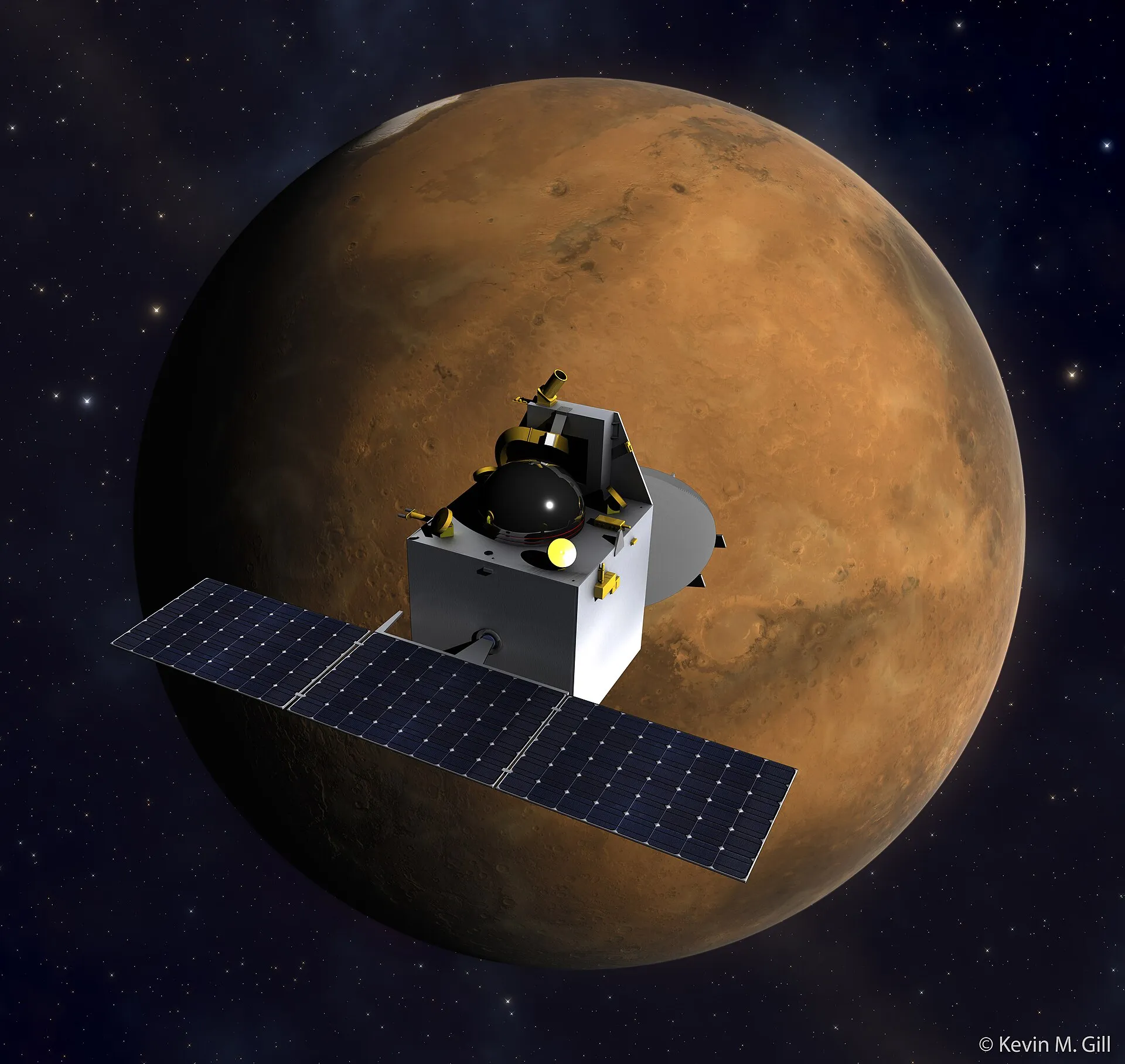
Then, early on the morning of 24 September 2014, a small spacecraft built in Bengaluru fired its engine for 24 minutes, slowed down, and slipped into orbit around the Red Planet. India had become the first country in the world to reach Mars on its maiden attempt, and the first Asian nation to get there at all [1][2].
The mission was officially called the Mars Orbiter Mission. Across India, people simply called it Mangalyaan, the “Mars craft”.
From idea to launch in record time
The mission was approved in 2012, and ISRO had a narrow window to work in [2]. Mars and Earth line up favourably for travel only about once every 26 months. Miss that window, and you wait more than two years for the next one.
ISRO’s team designed, built and tested the spacecraft in roughly 15 months, a remarkably short time for an interplanetary mission [2]. To save time and money, they reused proven designs from earlier satellites and from Chandrayaan-1, India’s first Moon mission.
Mangalyaan lifted off on 5 November 2013 on a PSLV rocket from Sriharikota [2]. The PSLV, ISRO’s dependable workhorse, was not powerful enough to throw a spacecraft straight to Mars. So the engineers came up with a clever plan.
The slingshot route
Instead of heading directly for Mars, Mangalyaan first circled the Earth. Over several weeks, ISRO fired its engine at carefully chosen moments to stretch its orbit wider and wider, building up speed each time it swung close to Earth.
On 1 December 2013, a final burn pushed the spacecraft out of Earth’s grip and onto a long, curving path towards Mars [2]. Then came about 300 days of cruising through deep space, a journey of hundreds of millions of kilometres.
The most nervous moment came at the end. The spacecraft’s main engine had been sitting idle for around ten months. If it failed to restart, Mangalyaan would sail past Mars and be lost forever. A few days before arrival, ISRO test-fired the engine briefly. It worked. On 24 September, the full burn went to plan, and the craft settled into orbit [2].
Because radio signals took several minutes to travel from Mars to Earth, the team could only wait for confirmation that the manoeuvre had already happened [2].
The cost that made headlines
What caught the world’s attention was the price. The mission cost around ₹450 crore, about US$74 million at the time [2]. That was less than the roughly $100 million budget of the Hollywood space film Gravity, a comparison the Prime Minister himself made [3].
How did ISRO do it? There was no single trick. The team reused existing designs, kept the spacecraft small and simple, and treated it first as a technology demonstration, with fewer instruments than larger Mars missions [2][3].
What Mangalyaan carried
The spacecraft was small, weighing about 1,340 kilograms at launch, most of it fuel. It carried five scientific instruments with a combined weight of only about 15 kilograms [1][2]:
- A colour camera to photograph the Martian surface and its two small moons [2].
- A methane sensor to look for methane in the Martian atmosphere, a gas that could hint at geological or even biological activity.
- A thermal infrared spectrometer to map the planet’s surface temperature and minerals.
- Two instruments to study the thin upper atmosphere of Mars and how it is being stripped away into space.
The main goal, however, was to prove that India could design, navigate and operate a spacecraft across interplanetary distances [3]. In that, it succeeded completely.
Six months planned, eight years delivered
Mangalyaan was designed to work for six months. It kept going for about eight years [4].
During that time it sent back many images, including full-disc pictures of Mars that showed the whole planet at once, and scientific results on Mars and its environment [2][4].
The spacecraft survived long eclipses, when the planet blocked sunlight from its solar panels, by careful power management. In 2022, after a very long eclipse, ISRO finally lost contact with it. The agency announced that the spacecraft was non-recoverable and the mission had ended, having outlived its planned life many times over [4].
The people behind it
Behind Mangalyaan was a large team of ISRO scientists and engineers, women and men, whose celebration at mission control was seen around the world.
The mission was carried out under then ISRO chairman K. Radhakrishnan [2].
How the world reacted
The mission was widely praised abroad. Time magazine named it among the best inventions of 2014 [2]. ISRO became only the fourth space agency to reach Mars, after the former Soviet space programme, NASA and the European Space Agency [2].
At home, it gave a boost to national confidence. It showed that Indian science could compete at the highest level, not by copying others, but by finding its own frugal, inventive path.
A legacy for the next generation
Mangalyaan opened doors, giving ISRO hard-won experience in operating a spacecraft far from Earth.
It also changed how many young Indians saw their own future. A child in a small town could now look up at the night sky, find the reddish dot of Mars, and know that something built in India had travelled all the way there.
For a country whose space programme began with small sounding rockets in the 1960s, reaching Mars in 2014 on the very first try is a journey worth celebrating.
Sources
- [1] Mars Orbiter Mission spacecraft — Indian Space Research Organisation (ISRO). Accessed 11 October 2026.
- [2] Mars Orbiter Mission — Wikipedia. Accessed 11 October 2026.
- [3] Why India's Mars Orbiter Mission cost less than 'Gravity' movie — NBC News. Accessed 12 October 2026.
- [4] ISRO officially confirms end of Mars mission after eight years in orbit — Deccan Herald. Accessed 12 October 2026.
Last updated . Report a correction