The Pyramids of Assam: Inside the Royal Mounds of the Ahom Kings
The Moidams of Charaideo, royal burial mounds of the Ahom dynasty, became the Northeast's first cultural World Heritage Site in 2024.
By IndianGaurav team ·
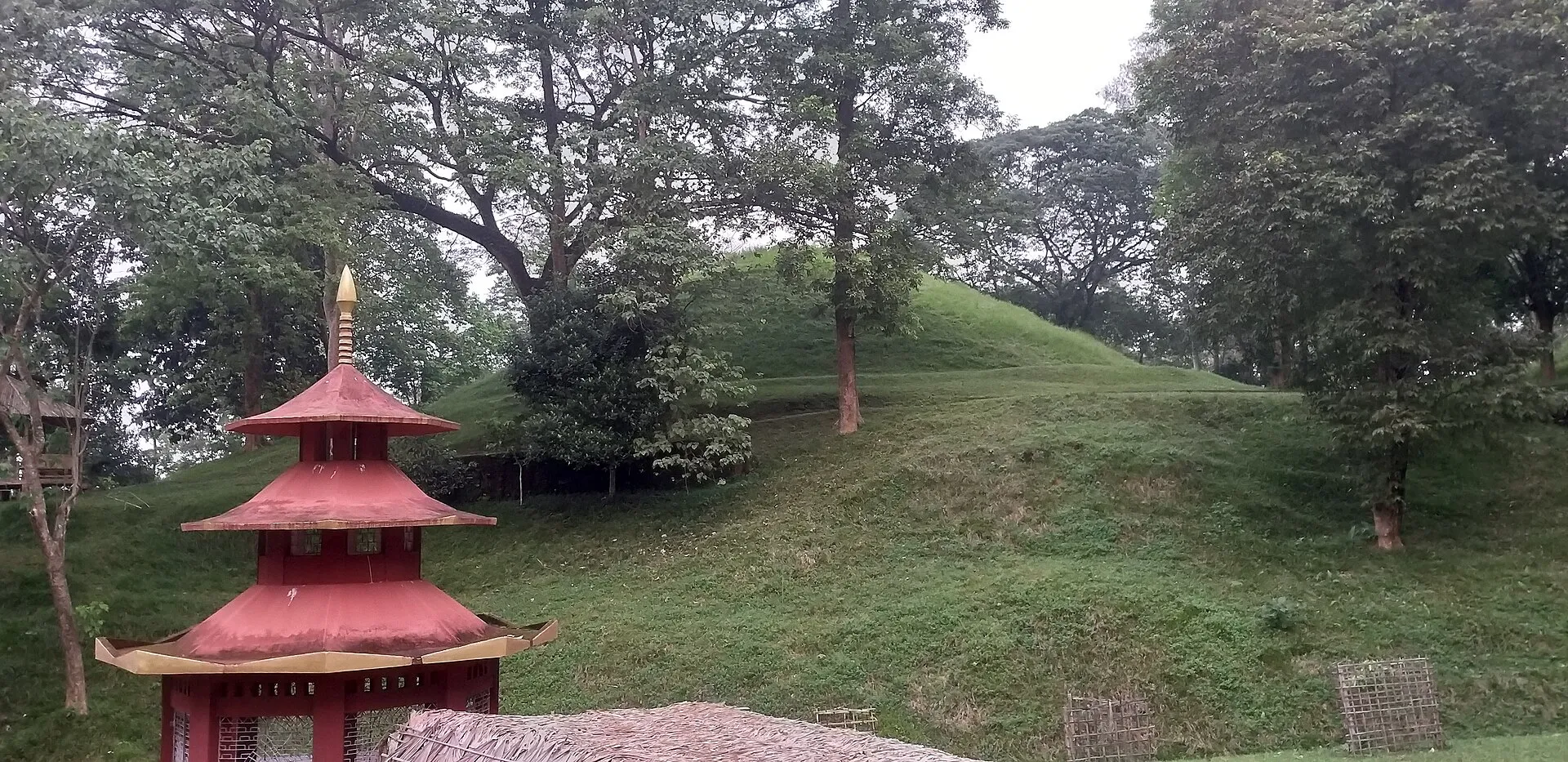
In the green foothills of eastern Assam rise dozens of grass-covered mounds. Some are small; others are as tall as a two-storey building. At first glance they look like natural hillocks.
They are not. These are the moidams, the royal burial mounds of the Ahom kings and queens, who ruled in Assam for about 600 years, from the 13th to the 19th century [2].
In July 2024, UNESCO added Moidams – the Mound-Burial System of the Ahom Dynasty to its World Heritage List [1][2]. It was the first cultural World Heritage Site in India’s Northeast [3].
The Ahom kingdom
In the 13th century, the Tai-Ahom people, led by Prince Sukaphaa, migrated into the Brahmaputra valley and chose Charaideo as their first capital and the burial ground of their kings [1]. Sukaphaa himself was buried at Charaideo in 1268 [5].
The Ahoms went on to rule much of present-day Assam, blending their Tai traditions with local culture. Their best-remembered hero is the general Lachit Borphukan, who led the Ahom forces to a decisive victory over a Mughal army at the Battle of Saraighat on the Brahmaputra in 1671 [6][7]. Since 1999, the best cadet at India’s National Defence Academy has received the Lachit Borphukan Gold Medal [7].
How a moidam was built
A moidam is a carefully planned structure, not just a heap of earth. UNESCO describes its parts [1]:
- a hollow vault of brick, stone or earth at the base
- a large earth mound raised over the vault
- a small shrine on top, the chow chali
- an octagonal wall around it
There are ninety moidams of different sizes within the World Heritage site, in the foothills of the Patkai range [1].
A different tradition
The moidams reflect the Tai-Ahom people’s own beliefs about death and the afterlife. While most traditions in the region cremated their dead, the Ahom royal family buried theirs in these mounds for centuries [1][5].
Rituals that continue
The moidams are not just ruins. Tai-Ahom rituals of ancestor worship, Me-Dam-Me-Phi, and of offering libations, Tarpan, are still performed at Charaideo [1].
A milestone for the Northeast
The decision was taken at the 46th session of the World Heritage Committee, held in New Delhi in July 2024 [2]. The Northeast already had natural World Heritage Sites, Kaziranga and Manas, but this was the region’s first cultural one [3]. All India Radio reported it as India’s 43rd World Heritage Site [4].
Visiting Charaideo
Charaideo is in eastern Assam, a short drive from Sivasagar, another former Ahom capital full of historic monuments. The cooler, drier months from October to March are the most pleasant time to visit. Walking among the quiet mounds, with birdsong and wind in the trees, is a peaceful experience.
Why it matters
The moidams tell the story of a dynasty that ruled for six centuries and created a culture all its own. Their recognition by UNESCO brings long-overdue attention to the history of the Northeast, a region whose part in India’s story deserves to be far better known.
Sources
- [1] Moidams – the Mound-Burial System of the Ahom Dynasty — UNESCO World Heritage Centre. Accessed 11 October 2026.
- [2] Decision 46 COM 8B.16 — UNESCO World Heritage Centre. Accessed 11 October 2026.
- [3] Moidams — Press Information Bureau, Government of India. Accessed 11 October 2026.
- [4] Moidams of Assam receives UNESCO World Heritage Site tag in the cultural category — News On AIR (All India Radio). Accessed 11 October 2026.
- [5] Moidams — Encyclopaedia Britannica. Accessed 11 October 2026.
- [6] PM addresses closing ceremony of year-long celebrations of 400th birth anniversary of Lachit Borphukan — Press Information Bureau, Government of India. Accessed 11 October 2026.
- [7] 400th Birth Anniversary of Lachit Borphukan — Press Information Bureau, Government of India. Accessed 11 October 2026.
Last updated . Report a correction