Two Lakh Lunches, Almost No Mistakes: The Genius of Mumbai's Dabbawalas
Every day, Mumbai's dabbawalas deliver home-cooked lunches across the city with legendary accuracy, using bicycles, trains and a simple colour code.
By IndianGaurav team ·
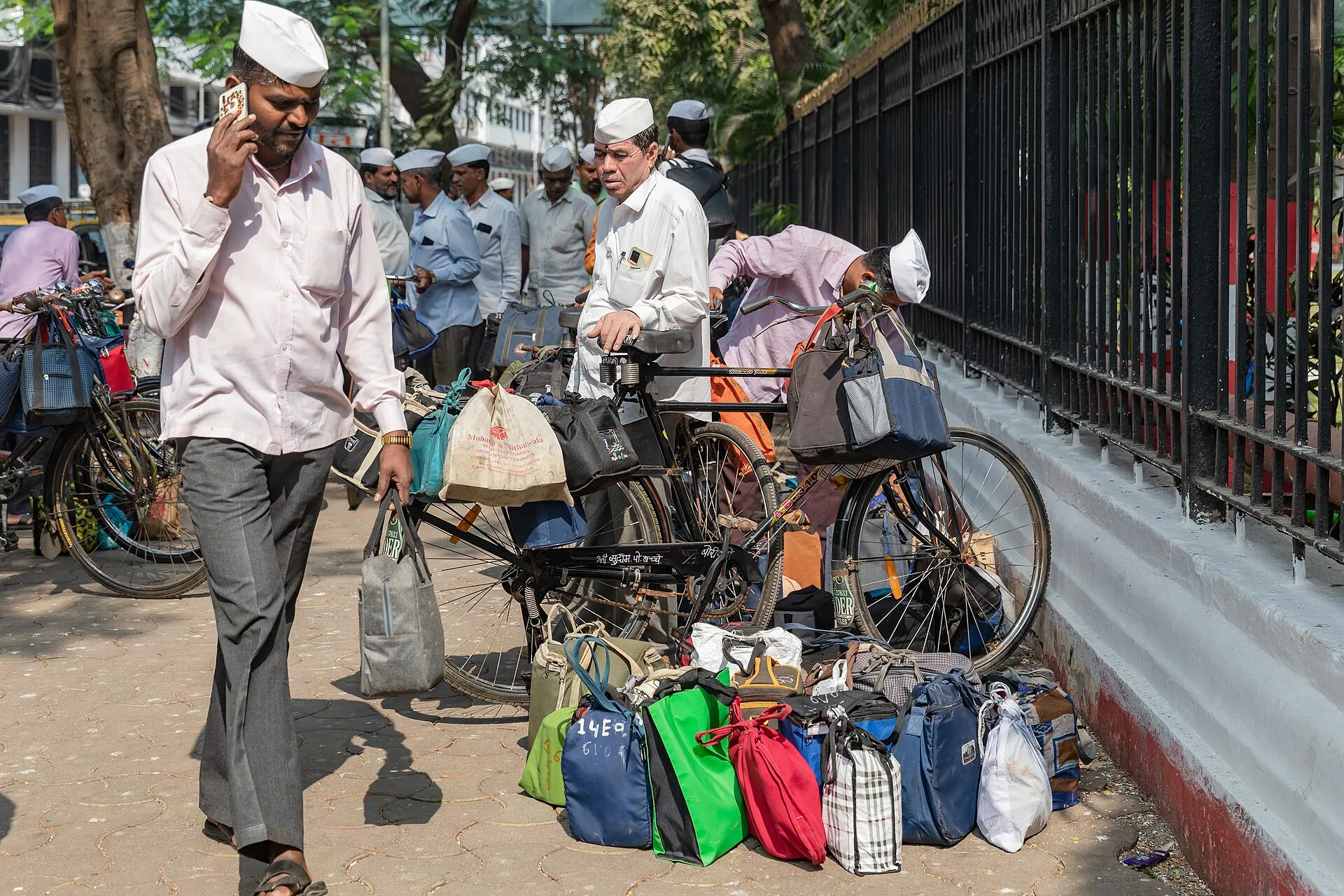
Every weekday morning in Mumbai, in thousands of homes, someone packs a hot lunch into a metal tiffin box: dal, rice, sabzi, chapatis.
By mid-morning, a man in a white cap collects it from the doorstep. It travels by bicycle, then by local train, then by handcart, passing through several hands. By lunchtime it is on the right desk in an office many kilometres away, and in the afternoon the empty box makes the same journey home.
The people behind this are Mumbai’s dabbawalas. Their association says more than 5,000 of them deliver over two lakh lunch boxes a day [1].
More than a century of service
The service goes back to the late 19th century, when a Parsi banker wanted a home-cooked lunch at his office [1]. Mahadeo Havaji Bachche turned lunch delivery into an organised team service, starting with about 100 dabbawalas [1]. The Mumbai Dabbawala Association dates its founding to 1890 [5].
How the system works
The system runs almost entirely on people, trains and a simple painted code [2]:
- Pickup. In the morning, a dabbawala collects tiffins from the homes in his area.
- Sorting. At the nearest railway station, boxes from different collectors are sorted by destination.
- Train journey. The boxes ride Mumbai’s local trains in long wooden crates.
- Second sorting. At the destination station, they are sorted again by area and building.
- Delivery. Dabbawalas carry them by bicycle, handcart or on their heads, arriving by lunchtime.
- Return. In the afternoon, the whole process runs in reverse.
A code anyone can read
How does each box find its way? A simple code painted on the lid, using colours, numbers and letters, marks where it was collected, which station it goes to, and the building it must reach [2]. Many dabbawalas have little formal schooling, and the code is designed so that anyone can learn it quickly.
Famous for accuracy
The dabbawalas are famous for how rarely they make mistakes. Their association says a 1998 study by Forbes gave their service a Six Sigma-level rating, a business term for near-perfect performance [1]. However the figure is measured, their reliability through monsoon floods, crowded trains and traffic is real. Management students have studied them too: IIM Raipur, among others, has drawn lessons from their methods [3].
Royal admirers
When Prince Charles, now King Charles III, visited Mumbai, he met the dabbawalas on their rounds, and they were later invited to his wedding in London in April 2005 [1][5]. They sent a paithani sari, Kolhapuri sandals and a Maratha turban as wedding gifts [4].
Why it matters
Mumbai’s dabbawalas show that excellence does not depend on expensive technology or formal degrees. It comes from a clear system, teamwork, discipline and pride in the work: delivering a home-cooked meal, on time, to someone working far from home.
Sources
- [1] Mumbai Dabbawala — official website — Mumbai Dabbawala Association. Accessed 11 October 2026.
- [2] A Day with Dabbawala — Mumbai Dabbawala Association. Accessed 11 October 2026.
- [3] Mumbai dabbawalas inspire IIM-Raipur — Business Standard. Accessed 11 October 2026.
- [4] Society page — dabbawalas' gifts for the royal wedding — The Tribune. Accessed 11 October 2026.
- [5] Mumbai's dabbawalas buy turban for Harry, saree for Meghan — Business Standard (PTI). Accessed 11 October 2026.
Last updated . Report a correction