Nine Million Books and Students From Across Asia: The Wonder That Was Nalanda
For about 800 years, Nalanda in Bihar was one of the world's greatest centres of learning. Today its ruins are a UNESCO World Heritage Site.
By IndianGaurav team ·
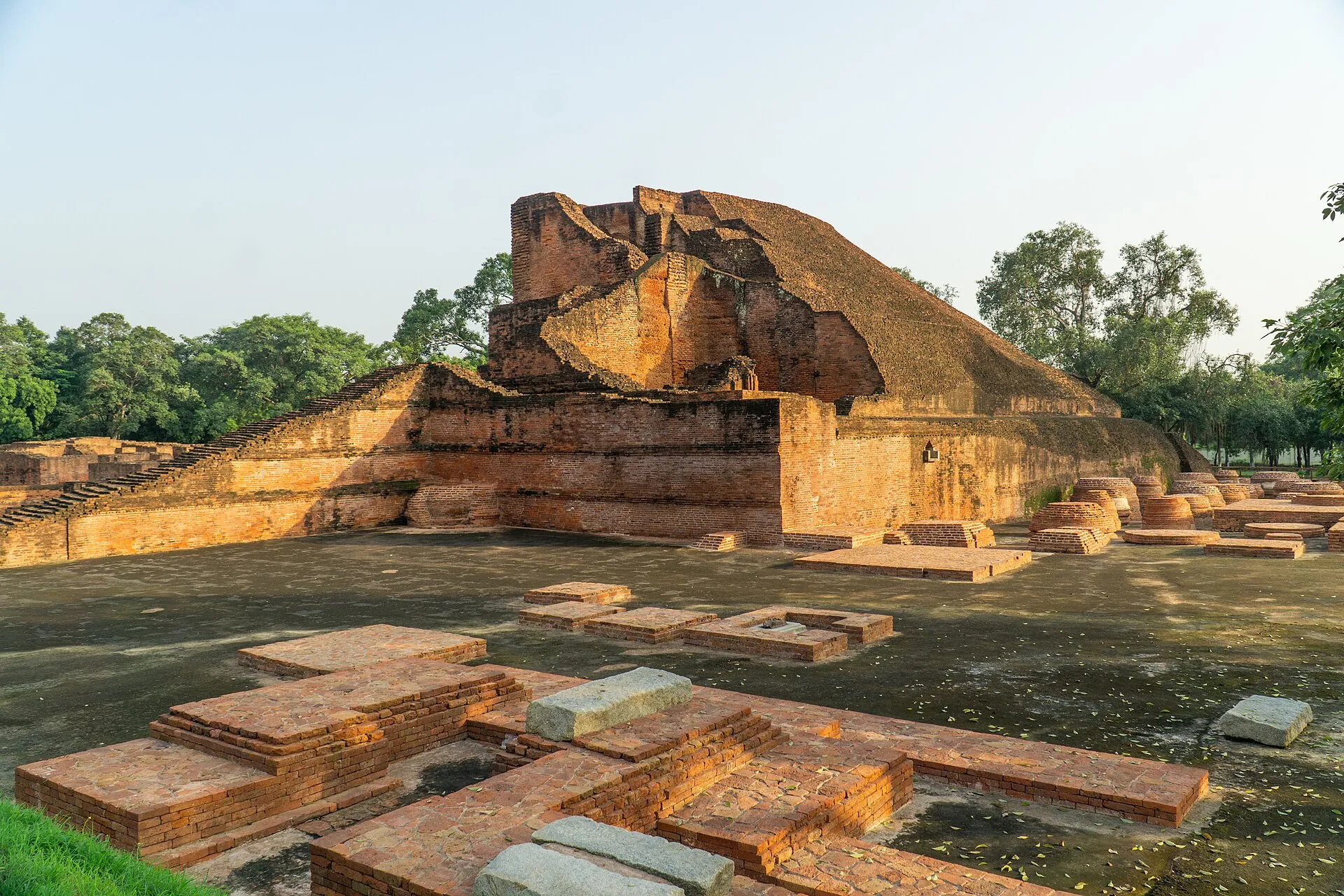
Long before Oxford, Cambridge or Bologna existed, students were travelling thousands of kilometres across mountains and deserts to study at a place in eastern India called Nalanda.
They came from China, Korea, Japan, Tibet, Mongolia, Sri Lanka and Southeast Asia [3]. According to the Chinese pilgrim Xuanzang, many had to pass a tough examination before they were even allowed through the gates [3]. Once inside, they joined a community of thousands of students and teachers, living, studying and debating together.
For around 800 years, from the 5th century to the end of the 12th century, Nalanda was one of the greatest centres of learning the world had ever seen [1][3].
Beginnings in the Gupta age
Nalanda lies in present-day Bihar, about 90 kilometres southeast of Patna, close to the ancient city of Rajgir. The area was already linked with the Buddha and with Mahavira, the 24th Jain tirthankara, who are both said to have spent time nearby [3].
The great mahavihara, or monastic university, was founded in the 5th century CE, during the reign of the Gupta dynasty. Historians usually credit King Kumaragupta I with its establishment [3]. Later rulers, including King Harsha in the 7th century and the Pala kings of Bengal and Bihar from the 8th to 12th centuries, continued to support and expand it.
A campus of brick and learning
The ruins visible today give a sense of how large and well planned Nalanda was. The excavated area covers about 23 hectares, and archaeologists believe the original complex was even bigger [1].
The campus was laid out in neat rows:
- Viharas, or monasteries, on one side, where students and teachers lived. Each had small rooms around a central courtyard, with niches for books and lamps.
- Temples and stupas on the other side, used for worship and meditation.
- Lecture halls, wells, kitchens, and meditation spaces in between.
UNESCO, which added the site to its World Heritage List in 2016 [5], describes Nalanda as the most ancient university of the Indian subcontinent and notes that it carried on its work without break for about 800 years [1]. The planning of its buildings influenced monastic architecture in other parts of Asia.
What was taught
Nalanda was a Buddhist institution, and Buddhist philosophy was at the centre of its studies. But its teachers and students explored a very wide range of subjects, including logic, grammar, medicine, mathematics, astronomy, the Vedas and other Indian philosophical traditions [3].
Debate was at the heart of education [3]. Students learned to argue carefully, to examine ideas from every side, and to defend or change their views based on reason. Some of the most important thinkers in Buddhist history are associated with Nalanda, including the philosophers Nagarjuna, Dharmakirti and Shantideva, according to later traditions [3].
Travellers’ tales
Much of what we know about life at Nalanda comes from the writings of Chinese pilgrims who studied there.
The most famous is Xuanzang (also spelled Hiuen Tsang). He travelled overland from China in the 7th century, crossing deserts and mountains, and spent several years at Nalanda studying under its senior teacher, Shilabhadra. In his detailed account, he described a place of tall buildings, deep learning and strict discipline, where thousands of monks studied [3].
A few decades later, another Chinese monk, Yijing, spent around ten years at Nalanda. His writings describe its daily routine, its rules and its large community [3].
When Xuanzang returned to China, he carried hundreds of texts with him and spent the rest of his life translating them [3]. Through scholars like him, ideas from Nalanda spread across East Asia and shaped Buddhist thought for centuries.
The great library
Nalanda’s library, known as Dharmaganja (“mountain of truth”), is the stuff of legend. Later Tibetan sources describe three multi-storeyed buildings filled with manuscripts [3]. Some popular accounts claim it held as many as nine million manuscripts. That number cannot be confirmed, but it is clear that Nalanda held one of the largest collections of knowledge in the ancient world.
Life as a student
Life at Nalanda was disciplined. Accounts from visiting monks describe days that began early with bathing and prayer, followed by long hours of lectures, reading and discussion [3]. Teachers were highly respected, and senior scholars guided small groups of students through difficult texts.
Students were not charged fees in the way we think of them today. The university was supported by grants of land and villages from kings and wealthy donors. The income from these lands paid for food, clothing, lodging and medicine for the monastic community [3]. In effect, education at Nalanda was funded by society, so that learning could be open to anyone who proved worthy of it.
Destruction and memory
Nalanda’s decline was gradual, but its end came violently. Around the end of the 12th century, it was attacked and badly damaged by forces of the Turkic commander Bakhtiyar Khalji. According to traditional accounts, monks were killed and the library burned for a long time [3]. Without royal patrons, the great university faded away.
For centuries afterwards, its ruins lay buried under mounds of earth. In the 19th century, the British surveyor Francis Buchanan-Hamilton and later the archaeologist Alexander Cunningham identified the site. Large-scale excavations by the Archaeological Survey of India began in the early 20th century and revealed the remains we see today [3].
Nalanda reborn
In 2010, India’s Parliament passed a law to create a new Nalanda University, near the ancient site in Rajgir [2][5]. The idea had support from countries in the East Asia Summit, reflecting the old university’s role as a meeting place for Asian scholars [2].
The new university’s campus, designed as a “net zero” green campus with solar power, water recycling and lakes, was inaugurated on 19 June 2024 [2][4]. It offers postgraduate programmes in subjects such as history, ecology, Buddhist studies and international relations, and welcomes students from many countries, just as its ancestor did.
Why Nalanda still matters
Nalanda is more than a set of beautiful ruins. It is proof that, more than 1,500 years ago, India built an institution where people from many lands came together to learn, question and teach.
It reminds us that knowledge in India has always been valued, shared and debated. It also reminds us that knowledge can be lost, and must be protected.
Walking through the quiet red-brick courtyards today, it is easy to imagine the sound of students arguing over a point of logic, the scratch of a scribe copying a manuscript, or a tired pilgrim from China arriving at the gate after months on the road. That is the spirit India can be proud of, and hopes to revive.
Sources
- [1] Archaeological Site of Nalanda Mahavihara at Nalanda, Bihar — UNESCO World Heritage Centre. Accessed 11 October 2026.
- [2] Nalanda University — official website — Nalanda University. Accessed 11 October 2026.
- [3] Nalanda mahavihara — Wikipedia. Accessed 11 October 2026.
- [4] PM Modi inaugurates newly built campus of Nalanda University in Rajgir, Bihar — News On AIR (Prasar Bharati). Accessed 12 October 2026.
- [5] PM Modi inaugurates New Nalanda University Campus in Bihar today; know more about its history and heritage — Business Today. Accessed 12 October 2026.
Last updated . Report a correction