A Bridge That Lifts Its Arms for Ships: The New Pamban Bridge to Rameswaram
Opened in April 2025, the New Pamban Bridge in Tamil Nadu is India's first vertical-lift railway sea bridge, replacing a 1914 landmark.
By IndianGaurav team ·
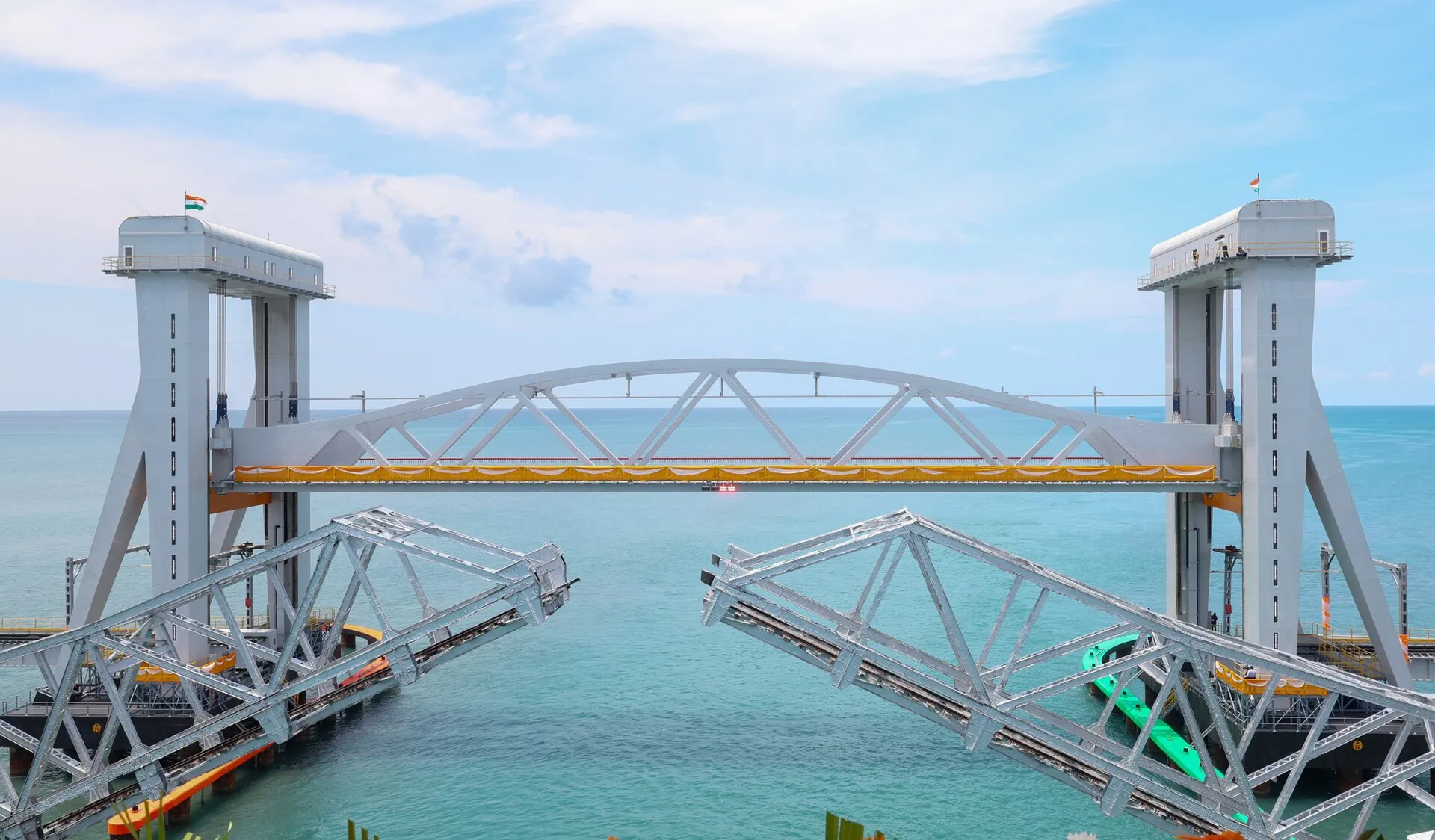
For more than a century, trains to the island of Rameswaram in Tamil Nadu crossed the sea on a low bridge that seemed to float on the waves. When a ship needed to pass, the middle of the bridge opened upwards in two halves.
On 6 April 2025, Prime Minister Narendra Modi opened its successor, the New Pamban Bridge, and used a remote control to raise its central span so that a Coast Guard ship could sail underneath [1].
It is India’s first vertical-lift railway sea bridge: instead of tilting open, its middle section rises straight up, staying level, like a lift [1][2].
Rameswaram and the sea
Rameswaram sits on Pamban Island, off India’s south-eastern tip, and is one of Hinduism’s holiest pilgrimage towns. For more than a hundred years, the railway bridge was the pilgrims’ gateway to the island [2].
The old bridge of 1914
British engineers built the original Pamban Bridge in 1914. Its famous feature was a Scherzer rolling lift span, a central section that rolled open to let ships through [2].
The bridge survived a great deal. In December 1964, a severe cyclone struck the island. A passenger train bound for Dhanushkodi was swept into the sea, and the town of Dhanushkodi, at the tip of the island, was destroyed and never rebuilt [3][4]. The bridge was badly damaged too. A young railway engineer, E. Sreedharan, led the team that had it working again in about 46 days, a job expected to take months [3]. He later became famous as the “Metro Man” behind the Delhi Metro.
A hundred years on, the old bridge was struggling. Sea air had corroded its steel, and heavier, faster trains needed a stronger crossing [2]. In 2019, the government approved a replacement [2].
The new bridge
The New Pamban Bridge runs beside the old one. Its key features [1][2]:
- Length: about 2.08 km across the sea, with 99 spans
- Vertical lift span: a 72.5-metre central section that can rise by up to 17 metres, letting larger ships pass
- Higher deck: 3 metres higher than the old bridge
- Room to grow: foundations built for two tracks, though only one is laid for now
It was built by Rail Vikas Nigam Limited (RVNL), a public sector company under the Ministry of Railways [2].
Built to fight the sea
Salt, wind, waves and cyclones are hard on any structure. To survive them, the new bridge uses stainless steel reinforcement, high-grade protective paint, fully welded joints and a special polysiloxane coating against corrosion. The railways expect it to last more than 100 years with little maintenance [2].
Building it was difficult too. Strong currents, ship traffic and fishing boats ruled out the usual ways of placing the lift span. Instead, engineers slid the span along the piers in 90 separate moves, using a launching method checked by IIT Madras [2].
What it means for people
For pilgrims, residents and traders, the new bridge means faster, safer train journeys to Rameswaram. On opening day, a new train service between Rameswaram and Tambaram in Chennai was also flagged off [1]. With the span raised, larger vessels can now pass through the channel [2].
Two bridges, two eras
Today the old and new bridges stand side by side over the blue water: riveted steel from 1914 next to a 21st-century lift bridge.
Beyond them, at the end of the island, lie the ruins of Dhanushkodi, its church and railway station still standing among the dunes [4]. A trip across the new bridge and on to Dhanushkodi tells the whole story: the cyclone, the old bridge’s survival, and the new bridge’s arrival.
Why it matters
The New Pamban Bridge brings together faith, history and modern engineering. When its central span rises gently to let a ship pass, it is a small spectacle that stands for something larger: a country honouring its past while building for its future.
Sources
- [1] PM Modi inaugurates New Pamban Railway Bridge in Rameswaram — The News Minute. Accessed 11 October 2026.
- [2] Bridging Progress: The Rise of the New Pamban Bridge — Press Information Bureau, Government of India. Accessed 11 October 2026.
- [3] From Pamban to Kolkata and Delhi: The trail of Metroman E Sreedharan's success — The News Minute. Accessed 11 October 2026.
- [4] Caught in a time warp: Visiting land's end at Dhanushkodi — The News Minute. Accessed 11 October 2026.
Last updated . Report a correction