104 Satellites, One Rocket: ISRO's Record-Breaking Morning
On 15 February 2017, ISRO launched 104 satellites on a single rocket, a world record at the time. Here is how it was done.
By IndianGaurav team ·
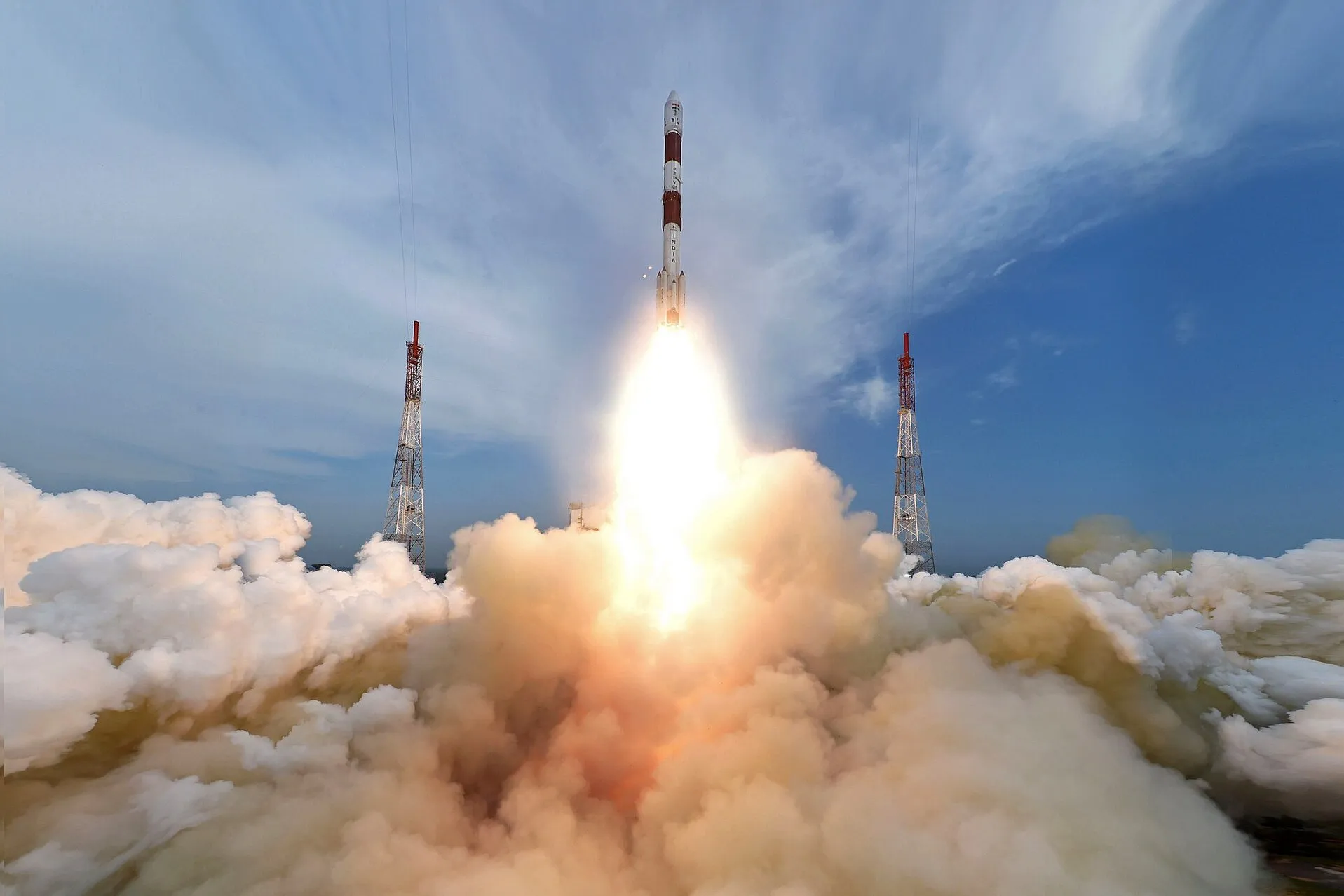
Early on the morning of 15 February 2017, a rocket rose from the launch pad at Sriharikota on the coast of Andhra Pradesh. It looked like any other launch. But inside the rocket’s nose was something no rocket had ever carried before: 104 satellites [1].
Within minutes of reaching orbit, the rocket released them one by one into orbit, like a careful postman dropping letters at a long row of houses. When the last satellite separated and ISRO confirmed that all of them were healthy, India had set a world record for the most satellites launched on a single rocket [1].
The mission was called PSLV-C37, and it launched from Sriharikota on 15 February 2017 [4]. It made headlines around the world and showed just how reliable and precise India’s space programme had become.
The workhorse rocket
The rocket that carried out this feat was the Polar Satellite Launch Vehicle, or PSLV. It is often called ISRO’s workhorse [2][3].
The PSLV first flew in 1993. After an early failure, it went on to become one of the most dependable rockets in the world, with a long run of successful launches [3]. It has carried Chandrayaan-1 to the Moon, the Mars Orbiter Mission towards Mars, and the Aditya-L1 solar observatory into space, along with many Indian and foreign satellites.
The PSLV has four stages, alternating between solid and liquid fuel, and can be flown in different versions depending on how heavy the load is. For PSLV-C37, ISRO used its most powerful version, called PSLV-XL, with six extra strap-on boosters [1].
Who were the passengers?
The 104 satellites were very different in size [1].
The main passenger was Cartosat-2D, an Indian Earth-observation satellite weighing about 714 kilograms [1][4]. Its cameras were designed to take detailed pictures of the ground, useful for city planning, mapping, roads, water resources and more.
Alongside it were two small Indian nanosatellites, INS-1A and INS-1B, built to test new technologies [1]. The largest group of passengers was 88 small satellites belonging to the US company Planet [4].
The remaining 101 satellites belonged to customers from other countries [1]. Most were tiny “Dove” satellites, each about the size of a shoebox, built by the American company Planet to photograph the Earth every day. There were also satellites from the Netherlands, Switzerland, Israel, Kazakhstan and the United Arab Emirates.
Altogether, the satellites weighed about 1,378 kilograms [1].
The challenge of not crashing into each other
Launching one satellite is hard enough. Launching 104 creates a special problem: how do you release them so that they do not bump into one another?
ISRO’s engineers solved this with careful planning and precise timing. After the rocket reached the right orbit, about 500 kilometres above the Earth, the satellites were released in a carefully worked-out sequence, each one pushed away in a slightly different direction and at a slightly different moment [1].
The fourth stage of the rocket also changed its orientation between releases, so that satellites flew off at different angles. The result was that, over time, the satellites drifted apart and spread out safely along their orbits.
The entire separation sequence was completed within a few minutes [1]. Everything happened automatically, guided by the rocket’s onboard computers.
A record that made the world notice
Before PSLV-C37, the record for most satellites on one rocket was 37, set by Russia in 2014. ISRO had itself launched 20 satellites in a single mission in 2016 [1].
By launching 104, ISRO nearly tripled the previous record of 37 satellites on one rocket, set by a Russian launch in 2014 [1].
The record stood until January 2021, when the American company SpaceX launched 143 satellites in one mission [1]. Even so, PSLV-C37 remains one of the landmark moments in the history of spaceflight, and the first time any rocket carried more than a hundred satellites at once.
Why it mattered for India
PSLV-C37 was not about records alone. It mattered for several reasons.
First, it showed that India could carry out highly complex missions with great precision. Releasing 104 satellites safely requires excellent control of the rocket, accurate software and careful planning.
Second, it was good business. Most of the satellites belonged to foreign customers, which helps build India’s reputation as a reliable launch partner [1][4].
Third, it was a boost to national confidence, coming three years after the success of the Mars Orbiter Mission.
The people behind it
As with all ISRO missions, PSLV-C37 was the work of a large team of scientists, engineers and technicians. The launch was the PSLV’s 38th successful mission in a row [4].
Their work also opened the door for India’s growing private space sector. Today, Indian start-ups are building their own satellites and rockets, and many of their engineers say they were inspired by missions like this one.
What the satellites did next
Once safely in orbit, the satellites got to work, with Cartosat-2D taking high-resolution images of the Earth [1].
The small Dove satellites joined a growing fleet that photographs the entire land surface of the Earth regularly. Their images are used for tracking crops, monitoring forests, measuring the growth of cities, responding to disasters and studying climate change.
In this way, a single launch from Sriharikota added to the world’s ability to watch over its own planet.
A morning to remember
For people watching that morning in February 2017, the drama came after the rocket reached orbit, as the satellites separated one after another over about 12 minutes [4].
When all 104 had separated, the scientists in the control room celebrated.
It was a reminder that sometimes the most impressive achievements are not the loudest. They are the ones that require patience, precision and teamwork, and get every small detail right.
Sources
- [1] PSLV-C37 — Wikipedia. Accessed 11 October 2026.
- [2] Polar Satellite Launch Vehicle — Indian Space Research Organisation (ISRO). Accessed 11 October 2026.
- [3] Polar Satellite Launch Vehicle — Wikipedia. Accessed 11 October 2026.
- [4] PSLV Launch with 104 Payloads Opens New Opportunities for Small Satellites — Forecast International. Accessed 12 October 2026.
Last updated . Report a correction