Forty-One Years After Rakesh Sharma: The Indian Who Floated Into the Space Station
In June 2025, IAF Group Captain Shubhanshu Shukla became the first Indian to board the International Space Station, on the Axiom-4 mission.
By IndianGaurav team ·
In April 1984, Indian Air Force pilot Rakesh Sharma became the first Indian to travel to space, aboard a Soviet spacecraft. When Prime Minister Indira Gandhi asked him from Earth how India looked from up there, he answered with a line from a famous patriotic song: “Saare jahan se achha”, better than the whole world [2].
For the next four decades, no other Indian citizen flew to space. A generation grew up hearing that story as history.
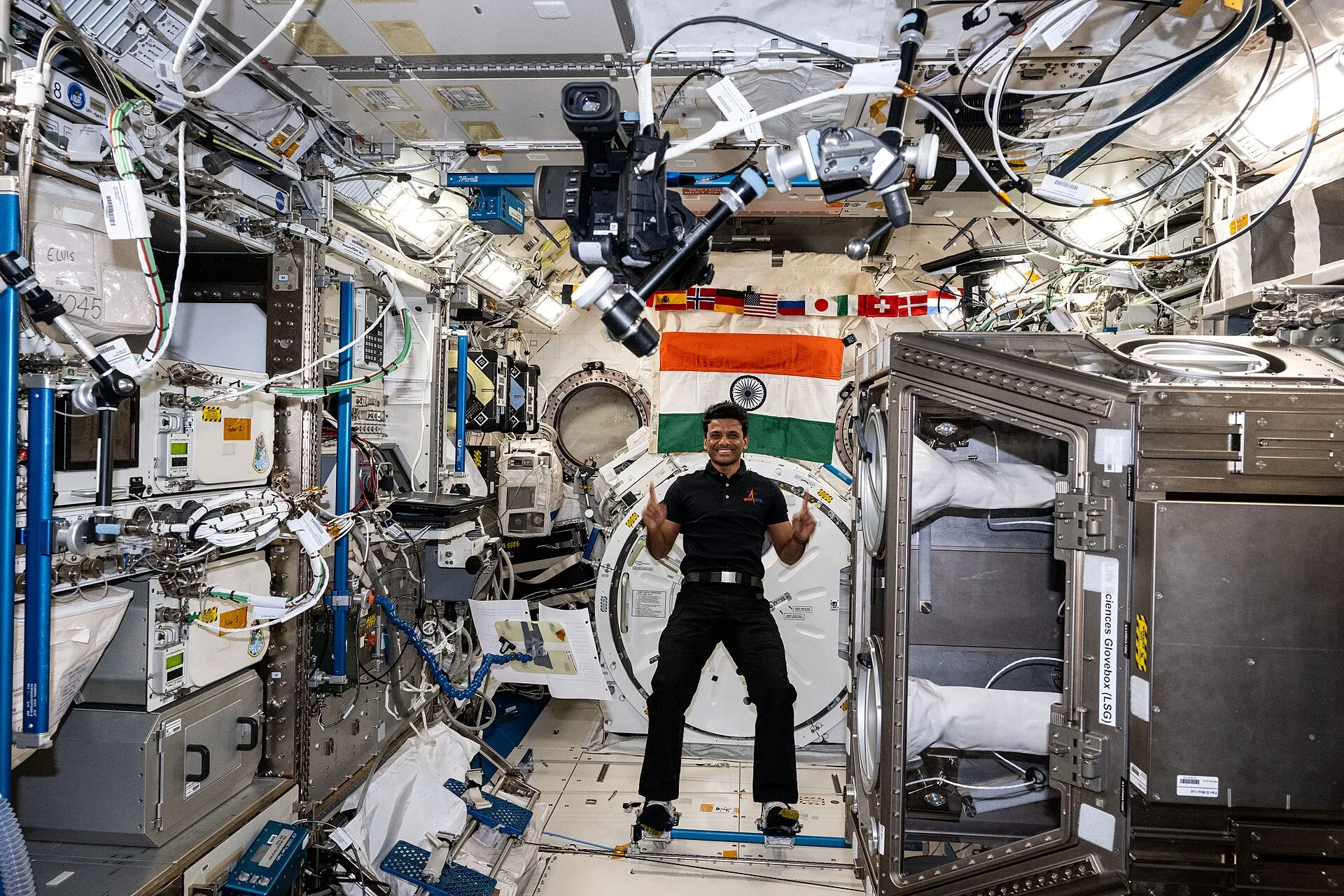
Then, on 25 June 2025, another Indian Air Force pilot strapped into a spacecraft in Florida. The next day, he floated through a hatch into the International Space Station, becoming the first Indian ever to go aboard the orbiting laboratory [1][2].
His name is Group Captain Shubhanshu Shukla.
A boy from Lucknow
Shubhanshu Shukla was born in 1985 in Lucknow, Uttar Pradesh [2]. He studied at City Montessori School, one of the city’s well-known schools, and went on to the National Defence Academy.
He joined the Indian Air Force as a fighter pilot in 2006 [2]. Over the years, he became an experienced test pilot and combat leader, flying aircraft such as the Su-30 MKI, MiG-21, MiG-29, Jaguar and Hawk, and logging around 2,000 hours of flying [2].
In 2019, he was among the Air Force pilots selected for India’s human spaceflight programme, Gaganyaan. He trained in Russia and in India. In February 2024, he was publicly named as one of the four astronaut-designates for Gaganyaan [2].
The Axiom-4 mission
Before sending its own astronauts on Gaganyaan, India wanted experience of real spaceflight. An opportunity came through Axiom-4, a commercial mission organised by the American company Axiom Space, with support from NASA and ISRO [1][3].
Shukla was chosen as the mission’s pilot, the second-in-command on the spacecraft. His crewmates were [3]:
- Peggy Whitson, a veteran American astronaut and the mission commander.
- Sławosz Uznański-Wiśniewski of Poland.
- Tibor Kapu of Hungary.
It was a historic flight for all three of the newer countries. Poland and Hungary, like India, were returning to human spaceflight after more than four decades.
The launch had been delayed several times for technical checks and weather [1]. Finally, on 25 June 2025, a SpaceX Falcon 9 rocket lifted off from the Kennedy Space Center in Florida, carrying the crew in a Dragon spacecraft named Grace [1][3]. The spacecraft docked with the International Space Station on 26 June 2025 [1].
Life aboard the station
The crew spent about 18 days on the space station [1]. Shukla’s days were packed with work.
He carried out seven experiments designed by Indian scientists and institutions [1]. Among them:
- Studies of how moong and methi seeds sprout in microgravity, with an eye on growing food during long space missions.
- Research on stem cells and on muscle loss in space.
- Experiments with microalgae, which could one day provide food, oxygen and fuel for astronauts.
- Studies on how astronauts interact with screens and how their thinking is affected by working in space.
He also took part in other experiments run by the international crew, and demonstrated the strange behaviour of water in zero gravity, where it forms floating bubbles [1].
Shukla spoke with Prime Minister Narendra Modi in a live video call from the station, and connected with schoolchildren and ISRO scientists through amateur radio and video links [1]. For many Indian children, it was their first chance to hear an Indian astronaut speaking from space in real time.
Coming home
On 14 July 2025, the Dragon spacecraft undocked from the space station, after a farewell ceremony with the station’s long-term crew [1]. On 15 July 2025, it splashed down safely in the Pacific Ocean off the coast of California [1].
After a period of medical checks and rehabilitation, as is normal after spaceflight, Shukla returned to India to a hero’s welcome.
Why this mission mattered
Axiom-4 was important for India in several ways.
It brought India back to human spaceflight. After 41 years, an Indian astronaut had once again flown to space, and this time had gone further: onto the International Space Station itself [1][2].
It gave valuable experience for Gaganyaan. India is preparing to launch its own astronauts on its own rocket from its own soil. Shukla’s first-hand experience of launch, life in orbit, docking, re-entry and recovery is useful for ISRO as it plans these missions [1].
It showcased Indian science. The experiments Shukla carried out were designed by Indian researchers. They gave Indian scientists access to the unique environment of space, and their results will help plan future missions.
It can inspire a new generation. Just as Rakesh Sharma’s flight inspired many Indians in the 1980s, Shubhanshu Shukla’s mission gives young people today a new example to look up to.
What it takes to become an astronaut
Becoming an astronaut takes years of preparation. Shukla and his fellow Gaganyaan astronaut-designates went through intense physical training, survival training for emergency landings on land and water, and long hours in simulators practising every stage of a flight [2].
They also had to study spacecraft systems, orbital mechanics, medicine, and the science behind the experiments they would carry out. For Axiom-4, Shukla trained with his international crewmates in the United States, learning the systems of the Dragon spacecraft and the International Space Station [3].
His background as a test pilot helped. Test pilots are trained to stay calm in emergencies, follow complex procedures precisely and report clearly on what they experience. These are exactly the qualities needed in space.
The road ahead
India’s space ambitions continue to grow. Gaganyaan aims to send Indian astronauts into orbit aboard an Indian spacecraft. India has also announced plans for its own space station, the Bharatiya Antariksh Station, and has set a long-term goal of landing an Indian on the Moon.
Shubhanshu Shukla is one of the people who will help make those plans real. His time on the International Space Station was not an end in itself but an important step on a much longer journey.
A message from orbit
During his mission, Shukla spoke about how small and connected the Earth looks from space, without borders between countries. Like Rakesh Sharma before him, he described India’s beauty as seen from orbit.
Four decades separate their flights. But both men share something special: they carried the hopes of more than a billion people with them, and brought back a reminder that Indians belong among the stars.
Sources
- [1] Key highlights from Shubhanshu Shukla's historic spaceflight — The Week (PTI). Accessed 11 October 2026.
- [2] Shubhanshu Shukla — Wikipedia. Accessed 11 October 2026.
- [3] Axiom Mission 4 — Wikipedia. Accessed 11 October 2026.
Last updated . Report a correction