182 Metres of Gratitude: The Story Behind the World's Tallest Statue
The Statue of Unity in Gujarat honours Sardar Vallabhbhai Patel, the man who helped unite more than 560 princely states into one India.
By IndianGaurav team ·
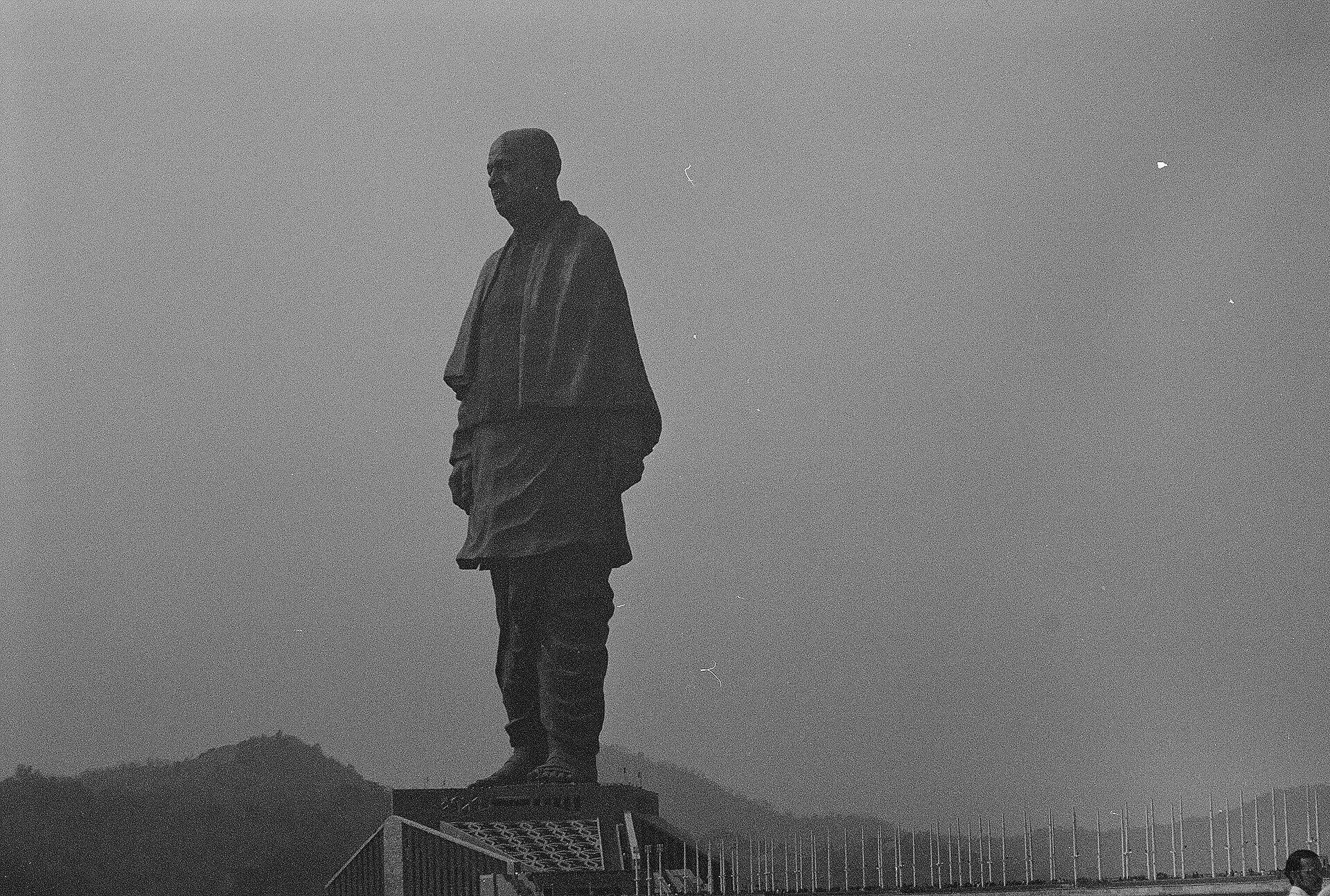
Rising from a small river island in Gujarat, the figure of a man in a simple shawl and dhoti looks out over the Narmada. He stands 182 metres tall, almost twice the height of the 93-metre Statue of Liberty [4]. Visitors at his feet look like ants.
This is the Statue of Unity, the tallest statue in the world [2][4]. But the story of why it was built is more interesting than its size. It honours a man whose quiet, determined work after Independence shaped the map of India we know today.
Who was Sardar Patel?
Vallabhbhai Patel was born on 31 October 1875 in Nadiad, Gujarat, into a farming family [3]. He trained as a lawyer, practised successfully, and could have lived a comfortable life. Instead, he joined the freedom movement under Mahatma Gandhi.
He first gained national fame in 1928, when he led farmers in Bardoli, Gujarat, in a peaceful protest against an unfair tax increase. The campaign succeeded, and the grateful farmers began calling him Sardar, meaning “leader” or “chief”. The title stayed with him for life [3].
After Independence in 1947, Patel became India’s first Deputy Prime Minister and Home Minister [3][4]. It was in this role that he did the work for which he is most remembered.
Uniting a divided land
When the British left, India was not one neat country. Alongside the provinces under direct British rule, there were more than 560 princely states, ruled by maharajas, nawabs and other local rulers [3]. Some were tiny. Others, such as Hyderabad and Mysore, were as large as many European countries.
Legally, these rulers could choose to join India, join Pakistan, or try to stay independent. Had many chosen independence, the new nation could have been broken into hundreds of pieces.
Patel, working closely with his senior civil servant V.P. Menon, took on the task of bringing these states into the Indian Union. Through patient negotiation, persuasion, appeals to patriotism, and firmness where it was needed, he convinced almost all of them to sign the Instrument of Accession [3]. Within a remarkably short time, the patchwork of states had become one country.
For this achievement, Patel is often called the Iron Man of India, and sometimes the “Bismarck of India”, after the German statesman who united Germany. He died on 15 December 1950. In 1991, he was posthumously awarded the Bharat Ratna, India’s highest civilian honour [3].
Building a giant
The idea of a giant memorial to Patel was announced in 2010 by the Gujarat government. The site chosen was Sadhu Bet, a rocky island in the Narmada river near the Sardar Sarovar Dam, in what is now Ekta Nagar (formerly Kevadia) in Narmada district [1][2]. The dam itself bears Patel’s name [2].
The statue was designed by the veteran Indian sculptor Ram V. Sutar, who was nearly 90 when construction began [2]. Sutar had spent a lifetime sculpting national figures [2].
Construction was carried out by the engineering company Larsen & Toubro, starting in 2014 [2]. The challenge was enormous:
- The core is a structure of reinforced concrete and steel, rising inside the figure like a skeleton.
- Over this sits a steel frame, and then an outer skin of bronze panels, cast in sections and fitted together like a giant jigsaw.
- The statue had to withstand strong winds and earthquakes. Engineers designed it to handle wind speeds of up to about 180 km/h and significant seismic activity [2].
- The figure stands with a slightly forward-leaning posture and feet apart, which is much harder to engineer than a stiff, upright pose.
More than 3,000 workers took part, and the project was finished in about three and a half years, at a cost of about ₹2,389 crore [4].
Unveiled on Patel’s birthday
The Statue of Unity was inaugurated on 31 October 2018, Patel’s 143rd birth anniversary [2][4]. That date is also observed every year as Rashtriya Ekta Diwas, or National Unity Day [3].
At 182 metres, the statue is about 29 metres taller than the Spring Temple Buddha in China, which had held the record [4].
What visitors can see
The statue is not just something to look at from a distance. High-speed lifts carry visitors up to a viewing gallery at about 153 metres, set inside the statue’s chest. From there, through narrow windows, visitors see the Sardar Sarovar Dam, the Narmada valley and the Satpura and Vindhya hills [1].
The surrounding area has grown into a major tourist destination. There is a memorial museum on Patel’s life and the integration of India, a light and sound show projected on the statue in the evening, a valley of flowers, river rafting, jungle safaris, a cactus garden and more [1]. Since opening, the site has drawn millions of visitors [2].
More than a monument
Like any very large public project, the statue has had its critics, who questioned its cost and its effect on nearby communities [2]. Supporters point to the jobs, tourism and development it has brought to what was once a remote tribal region. Both views are part of the story.
What is not in question is the importance of the man it honours. It is easy today to take a united India for granted. Patel’s work reminds us that it was not inevitable. It was built, state by state and conversation by conversation, by people who believed in one nation.
A message in a name
The statue was deliberately named the Statue of Unity, not the Statue of Patel. The name carries the message more than the man.
India is a country of many languages, faiths, cuisines and customs. The princely states that Patel brought together each had their own history and pride. What joined them was a shared idea of India.
Standing at the foot of the statue, looking up at its calm, determined face, many visitors say they feel that idea quite strongly. That may be the best measure of what the statue achieves.
Sources
- [1] Statue of Unity — official website — Statue of Unity Area Development and Tourism Governance Authority. Accessed 11 October 2026.
- [2] Statue of Unity — Wikipedia. Accessed 11 October 2026.
- [3] Vallabhbhai Patel — Wikipedia. Accessed 11 October 2026.
- [4] Modi unveils 'Statue of Unity' — The Quint (IANS). Accessed 12 October 2026.
Last updated . Report a correction