Where Tigers Swim and Forests Fight the Sea: The Wonder of the Sundarbans
The Sundarbans, shared by India and Bangladesh, is the world's largest mangrove forest and home to the swimming Royal Bengal tiger.
By IndianGaurav team ·
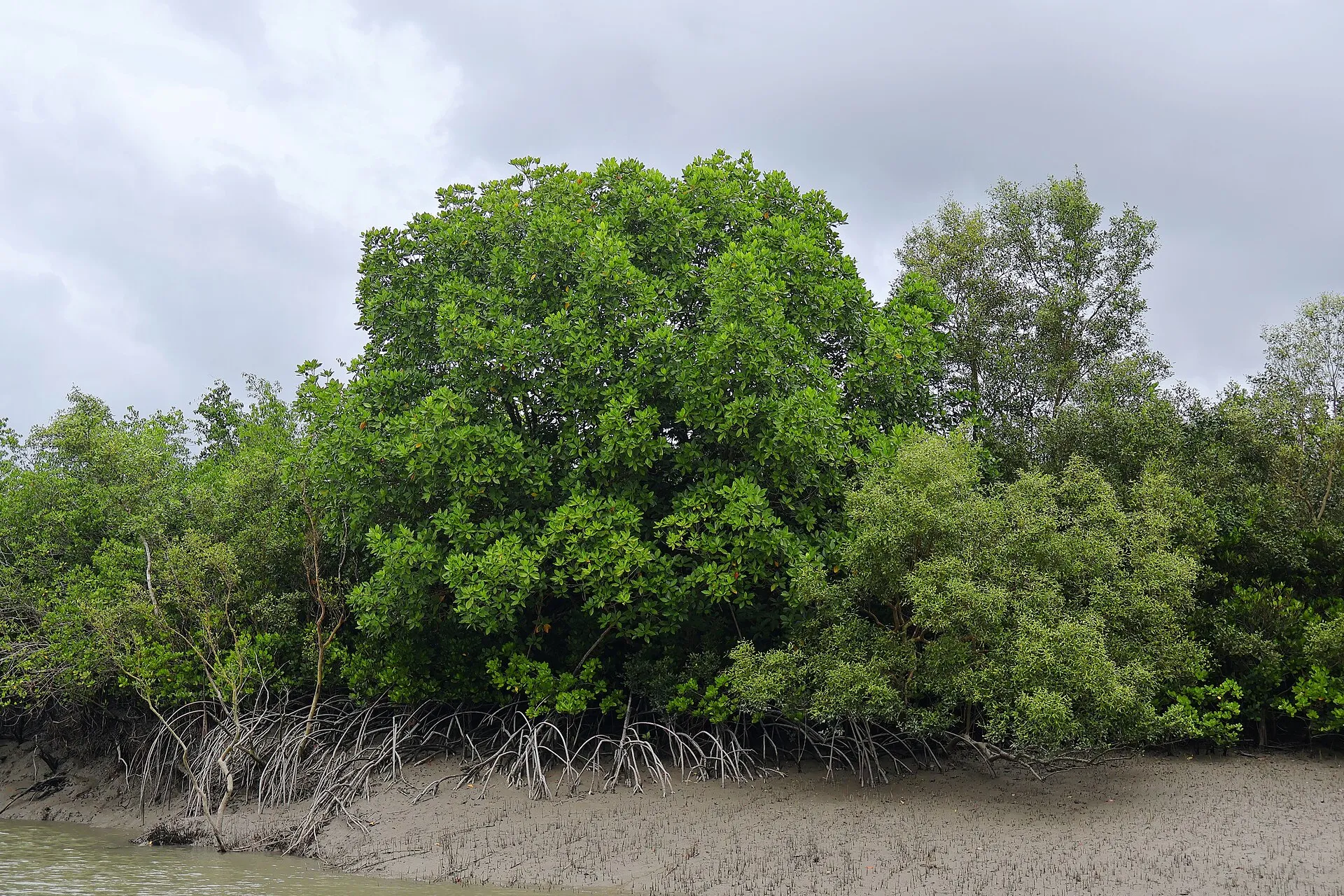
Twice a day the sea rushes in, and twice a day it pulls back. In the Sundarbans, the land seems to breathe with the tide. Rivers split into countless creeks, islands shift, and trees stand with their roots in salt water while pencil-thin roots poke up from the mud to breathe.
This is the world’s largest mangrove forest, spread across the delta of the Ganga and Brahmaputra where they meet the Bay of Bengal, and shared by India and Bangladesh [1]. About a third of it lies in India, in West Bengal [2].
UNESCO inscribed India’s Sundarbans National Park as a World Heritage Site in 1987 [1].
What are mangroves?
Mangroves are trees and shrubs that survive in salty, muddy coastal ground where most plants would die. Some send up breathing roots through the mud; others stand on stilt roots in the soft silt.
They also work hard for people. The Ramsar listing describes the Sundarbans mangroves as a natural shelter belt that protects the land behind them from storms, cyclones and tidal surges, and as a nursery for fish and shellfish that sustain fisheries along India’s whole eastern coast [3].
The swimming tiger
The Sundarbans is famous for its Bengal tigers, which live among the mangroves and swim the creeks between islands. UNESCO describes the wider biosphere reserve as the largest single continuous area for this threatened cat [5].
They are famously hard to see. Many visitors spend days on the water and see only pugmarks in the mud. The 2022 national tiger count put the Sundarbans Tiger Reserve at about 100 tigers [4].
A rich world of wildlife
The Ramsar listing records many threatened animals here [3]:
- estuarine (saltwater) crocodiles
- fishing cats, which hunt in the water
- Gangetic dolphins and Irrawaddy dolphins in the rivers
- nesting olive ridley, green and hawksbill turtles
A forest of many protections
The Indian Sundarbans is protected in several overlapping ways:
- a national park and tiger reserve [1][2]
- a UNESCO biosphere reserve since 2001 [2][5]
- a Ramsar site, a wetland of international importance, since 30 January 2019, covering 423,000 hectares [3]
People of the forest
Many people in the villages around the forest depend on it in certain seasons, working as fishers, honey gatherers, wood-cutters and collectors of leaves and grass [6]. It is risky work, because tigers roam the same creeks. Before entering the forest, local people seek the blessing of Bonbibi, the guardian goddess of the forest, for protection from tigers [6].
Challenges
The Sundarbans is under pressure. Cyclones such as Fani, Bulbul, Amphan and Yaas struck the region between 2019 and 2021, and the water is growing saltier [3]. Rising seas, conflict between people and tigers, and overfishing add to the strain.
Visiting the Sundarbans
Most visitors explore by boat, gliding through the creeks and stopping at forest watchtowers. The cooler months from October to March are the most comfortable. Drifting quietly through the waterways, watching kingfishers dart across the water, is an experience unlike anywhere else in India.
Why it matters
The Sundarbans protects millions of people from the sea, feeds the fisheries of the east coast and shelters one of the world’s most remarkable tiger populations. Keeping it healthy is one of India’s most important conservation tasks.
Sources
- [1] Sundarbans National Park — UNESCO World Heritage Centre. Accessed 11 October 2026.
- [2] Sundarbans National Park: World Heritage Property Data — UNESCO World Heritage Centre. Accessed 11 October 2026.
- [3] Ramsar Information Sheet — Sundarban Wetland, India (Site 2370) — Ramsar Convention Secretariat. Accessed 11 October 2026.
- [4] All India Tiger Estimation 2022: Release of the detailed Report — Press Information Bureau, Government of India. Accessed 11 October 2026.
- [5] Sunderban — Man and the Biosphere Programme — UNESCO. Accessed 11 October 2026.
- [6] Sundarbans National Park — advisory body evaluation — UNESCO World Heritage Centre. Accessed 11 October 2026.
Last updated . Report a correction