A Teardrop on the Cheek of Time: The Story Behind the Taj Mahal
Built by Shah Jahan in memory of Mumtaz Mahal, the Taj Mahal in Agra is one of the most admired buildings on Earth and a UNESCO World Heritage Site.
By IndianGaurav team ·
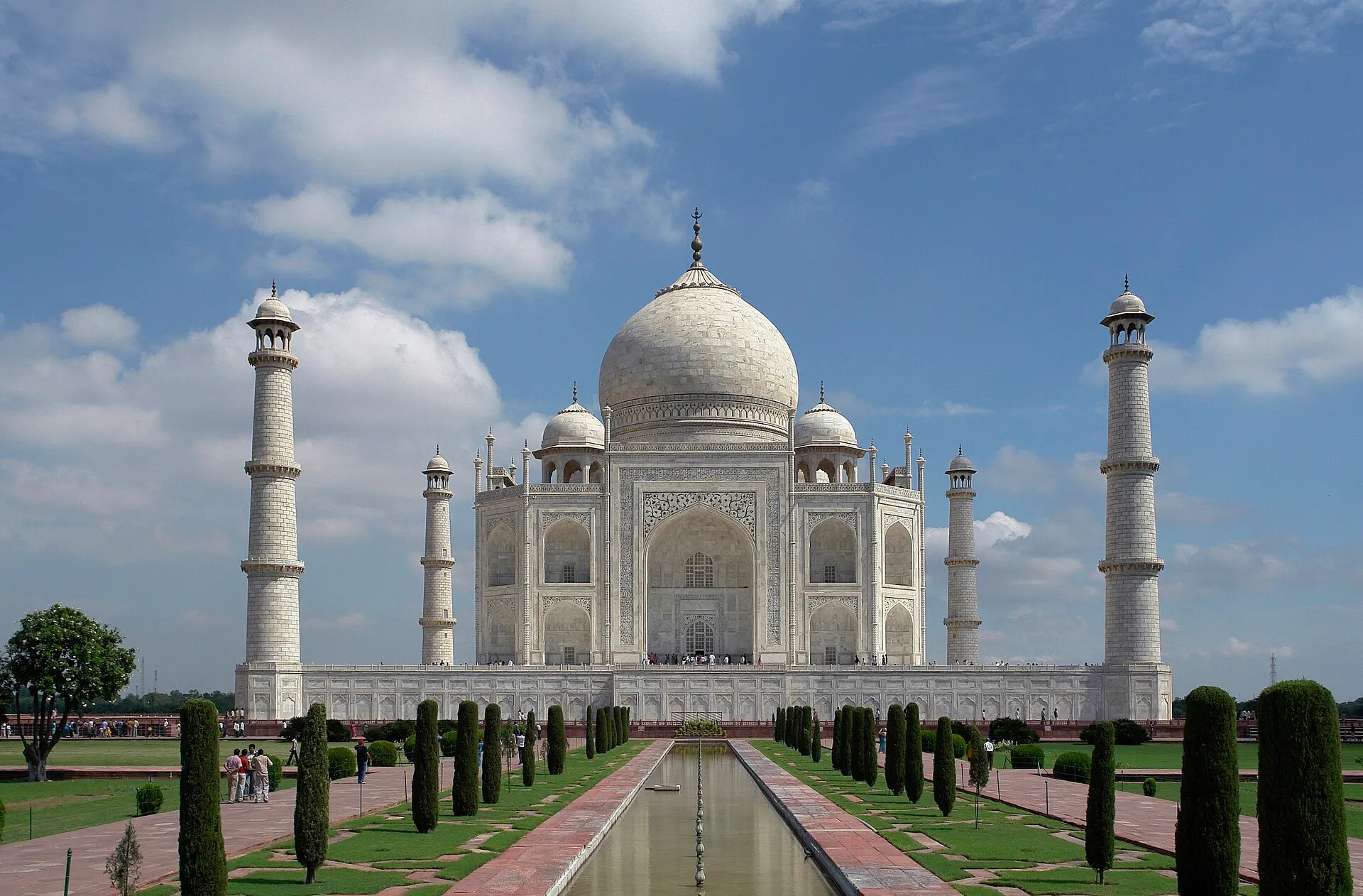
At dawn the Taj Mahal looks soft pink. At noon it shines a dazzling white, at sunset it turns golden, and under a full moon it seems to glow. People who have seen it many times say it never looks quite the same twice.
It stands on the bank of the Yamuna in Agra, Uttar Pradesh, and is one of the most famous buildings in the world. UNESCO inscribed it as a World Heritage Site in 1983 [1].
Before it became a symbol of India, though, it was something deeply personal: an emperor’s memorial to his wife.
A love story
Shah Jahan was the fifth Mughal emperor. His wife Mumtaz Mahal had been his inseparable companion since their marriage in 1612. In 1631, she died in childbirth [2]. The grieving emperor set out to build her a tomb unlike anything the world had seen.
Building a wonder
Work began in about 1632 [1][2]. The main tomb was finished in 1648, and the outer courtyards and cloisters in 1653 [1].
More than 20,000 workers took part, drawn from India, Persia, the Ottoman Empire and Europe [2]. The chief architect was probably Ustad Ahmad Lahauri [1][2], and the Quranic inscriptions were designed under the calligrapher Amanat Khan [2][3].
Perfect balance
What people admire most is the Taj Mahal’s harmony. A great white dome rises from a square base, with four slender minarets at the corners of its platform. Red sandstone buildings stand on either side, and in front lies a large charbagh, a Persian-style garden divided into four by water channels, its long pool reflecting the tomb [1].
Stone flowers
Up close, the marble walls are covered with flowers and vines made of semi-precious stones set into the marble, a technique called pietra dura [2]. Inside, the tomb is built around an eight-sided marble chamber decorated with carving and inlaid stones [2]. Shah Jahan, who died in 1666, was later laid to rest beside Mumtaz Mahal.
Protecting the Taj
In recent decades, air pollution began to yellow the white marble. On 30 December 1996, in a case brought by environmental lawyer M.C. Mehta, the Supreme Court ordered the creation of the Taj Trapezium Zone, about 10,400 square kilometres around Agra, with strict controls on polluting industry [7].
The Archaeological Survey of India also cleans the marble with a traditional mud pack of multani mitti (Fuller’s earth): a thin layer of clay draws out the dirt and is then washed off [6].
Visiting the Taj Mahal
The Taj Mahal is open from half an hour before sunrise to half an hour before sunset, and is closed on Fridays [4]. On five nights each month, around the full moon, small groups can view it at night [5].
Arrive early to beat the crowds and the heat, and to watch the marble change colour in the morning light.
Why it matters
The Taj Mahal brings together the skills of thousands of craftspeople, the vision of great architects and materials from across Asia. It is a masterpiece of Indo-Islamic architecture, and above all a reminder that love and loss are universal. Nearly four centuries on, people from every country and faith still stand before it in silence.
Sources
- [1] Taj Mahal — UNESCO World Heritage Centre. Accessed 11 October 2026.
- [2] Taj Mahal — Encyclopaedia Britannica. Accessed 11 October 2026.
- [3] Creation History — Taj Mahal official website, Government of Uttar Pradesh. Accessed 11 October 2026.
- [4] Visiting Hours — Taj Mahal official website, Government of Uttar Pradesh. Accessed 11 October 2026.
- [5] Night View — Taj Mahal official website, Government of Uttar Pradesh. Accessed 11 October 2026.
- [6] Taj Mahal to get 'mud-pack treatment' soon — Business Standard (PTI). Accessed 11 October 2026.
- [7] SC lifts ban on construction, industrial activities in Taj Trapezium Zone — Business Standard (ANI). Accessed 11 October 2026.
Last updated . Report a correction