Arrival: Vikram-1 Becomes India's First Private Rocket to Reach Orbit
On 18 July 2026 Skyroot Aerospace's Vikram-1 reached orbit on its first flight, making India the third country, after the US and China, where a private company has done so.
By IndianGaurav team ·
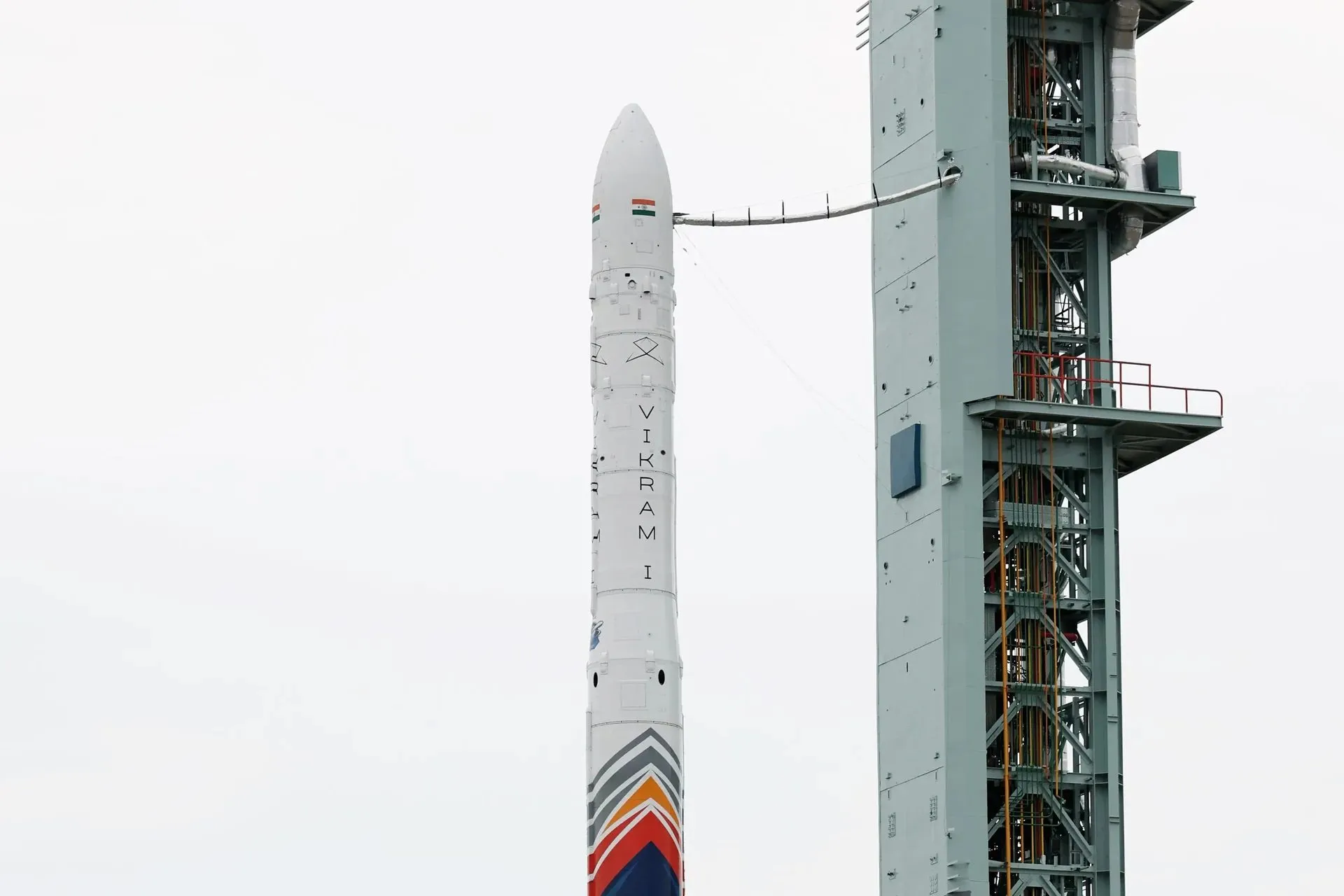
For more than half a century, every Indian rocket that reached orbit was built by one organisation: ISRO. That changed shortly after noon on 18 July 2026, when a 22-metre rocket made by a Hyderabad start-up lifted off from Sriharikota and, about a quarter of an hour later, was circling the Earth [1][2].
The rocket was Vikram-1, built by Skyroot Aerospace. The flight was named Aagaman, a Sanskrit word for “arrival” [2][3].
A first flight that worked
Vikram-1 took off from the Satish Dhawan Space Centre at 12:05 pm and reached an orbit about 450 km up roughly 15 minutes later [1][3]. Its upper stage then released several customer satellites and experiments [2]. Remarkably, this was the rocket’s very first attempt [1].
With it, India became only the third country, after the United States and China, where a home-grown private company has put a rocket into orbit [1][3].
The rocket
Vikram-1 weighs about 40 tonnes at lift-off and can carry up to 350 kg into low Earth orbit, aimed at the fast-growing market for small satellites [1][3]. Three solid-fuel stages are topped by a liquid-fuelled stage whose engine is 3D-printed [1]. That final stage can manoeuvre in space to drop each satellite in its chosen orbit [3]. Unlike ISRO’s aluminium-bodied rockets, Vikram-1 is built largely of carbon composite, which is lighter for its strength [3].
The rocket is named after Vikram Sarabhai, regarded as the founder of India’s space programme [3].
Eight years from idea to orbit
Skyroot was founded in 2018 by Pawan Kumar Chandana and Bharath Dhaka, two former ISRO scientists [2][3]. In November 2022 its small Vikram-S rocket became the first privately developed Indian rocket to fly to space, on a short sub-orbital hop [2][3].
That journey was possible because India opened rocket and satellite building to private firms in 2020 [1][3]. Six years later the country had around 400 space start-ups [1][2], and Skyroot had become the first Indian space company valued at more than a billion dollars [1][3].
After the launch, the company’s chief executive said the flight showed India had the skills and industry to build world-class rockets [1].
What comes next
One successful launch is only the start of a launch business. Skyroot plans further test flights to show the rocket can fly reliably, aims to double production at its Hyderabad factory to two rockets a month, and is working on an upgraded Vikram-1 and a larger Vikram-2 [2]. For India’s young private space industry, though, the July flight was the moment the promise became real.
Sources
- [1] India's Space Industry Push Pays Off With Successful Launch — IEEE Spectrum. Accessed 17 November 2026.
- [2] Skyroot Aerospace Reaches Orbit with Vikram-1 Rocket — Payload. Accessed 17 November 2026.
- [3] Vikram-1 Explained: Why India's First Private Orbital Rocket Is A Historic Milestone — Outlook India. Accessed 17 November 2026.
Last updated . Report a correction